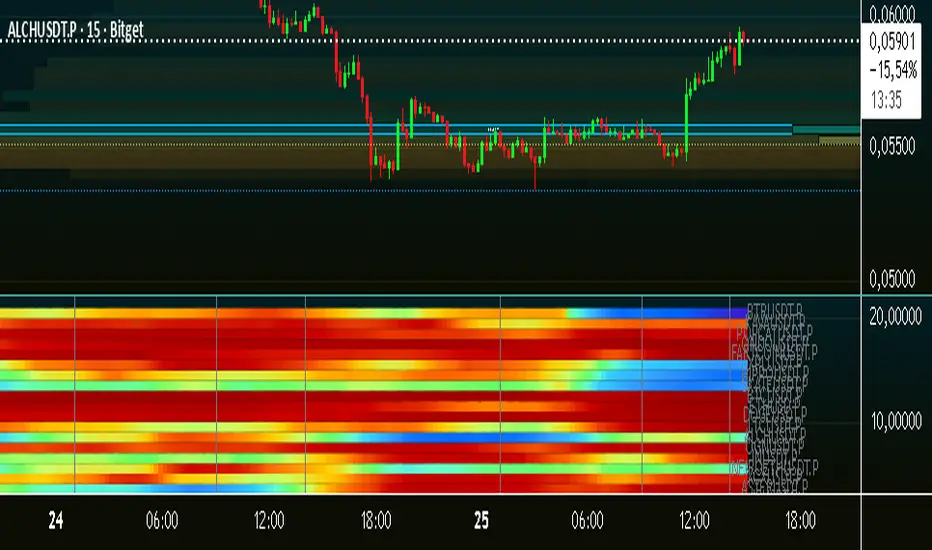
DafeRLMLLibDafeRLMLLib: The Reinforcement Learning & Machine Learning Engine
This is not an indicator. This is an artificial intelligence. A state-based, self-learning engine designed to bring the power of professional quantitative finance to the Pine Script ecosystem. Welcome to the next frontier of trading analysis.
█ CHAPTER 1: THE PHILOSOPHY - FROM STATIC RULES TO DYNAMIC LEARNING
Technical analysis has, for a century, been a discipline of static, human-defined rules. "If RSI is below 30, then buy." "If the 50 EMA crosses the 200 EMA, then sell." These are fixed heuristics. They are brittle. They fail to adapt to the market's ever-changing personality—its shifts between trend and range, high and low volatility, risk-on and risk-off sentiment. An indicator built on static rules is an automaton, destined to fail when the environment it was designed for inevitably changes.
The DafeRLMLLib was created to shatter this paradigm. It is not a tool with fixed rules; it is a framework for discovering optimal rules. It is a true Reinforcement Learning (RL) and Machine Learning (ML) engine, built from the ground up in Pine Script. Its purpose is not to follow a pre-programmed strategy, but to learn a strategy through trial, error, and feedback.
This library provides a complete, professional-grade toolkit for developers to build indicators that think, adapt, and evolve. It observes the market state, selects an action, receives a reward signal based on the outcome, and updates its internal "brain" to improve its future decisions. This is not just a step forward; it is a quantum leap into the future of on-chart intelligence.
█ CHAPTER 2: THE CORE INNOVATIONS - WHAT MAKES THIS A TRUE ML ENGINE?
This library is not a collection of simple moving averages labeled as "AI." It is a suite of genuine, academically recognized machine learning algorithms, adapted for the unique constraints and opportunities of the Pine Script environment.
Multi-Algorithm Architecture: You are not locked into one learning model. The library provides a choice of powerful RL algorithms:
Q-Learning with TD(λ) Eligibility Traces: A classic, robust algorithm for learning state-action values. We've enhanced it with eligibility traces (Lambda), allowing the agent to more efficiently assign credit or blame to a sequence of past actions, dramatically speeding up the learning process.
REINFORCE Policy Gradient with Baseline: A more advanced method that directly learns a "policy"—a probability distribution over actions—instead of just values. The baseline helps to stabilize learning by reducing variance.
Actor-Critic Architecture: The state-of-the-art. This hybrid model combines the best of both worlds. The "Actor" (the policy) decides what to do, and the "Critic" (the value function) evaluates how good that action was. The Critic's feedback is then used to directly improve the Actor's decisions.
Prioritized Experience Replay: Like a human, the AI learns more from surprising or significant events. Instead of learning from experiences in a simple chronological order, the library stores them in a ReplayBuffer. It then replays these memories to the learning algorithms, prioritizing experiences that resulted in a large prediction error. This makes learning incredibly efficient.
Meta-Learning & Self-Tuning: An AI that cannot learn how to learn is still a dumb machine. The MetaState module is a meta-learning layer that monitors the agent's own performance over time. If it detects that performance is degrading, it will automatically increase the learning rate ("Synaptic Plasticity"). If performance is improving, it will decrease the learning rate to stabilize the learned strategy. It tunes its own hyperparameters.
Catastrophic Forgetting Prevention: A common failure mode for simple neural networks is "catastrophic forgetting," where learning a new task completely erases knowledge of a previous one. This library includes mechanisms like soft_reset and L2 regularization to prevent the agent's learned weights from exploding or being wiped out by a single bad run of trades, ensuring more stable, long-term learning.
The Universal Socket Interface: How does the AI "see" the market? Through DataSockets. This brilliant, extensible interface allows a developer to connect any data series—an RSI, a volume metric, a volatility reading, a custom calculation—to the AI's "brain." Each socket normalizes its input, tracks its own statistics, and feeds into the state-building process. This makes the library universally adaptable to any trading idea.
█ CHAPTER 3: A DUAL-PURPOSE FRAMEWORK - MODES OF OPERATION
This library is a foundational component of the DAFE AI ecosystem, designed for ultimate flexibility. It can be used in two primary modes: as a powerful standalone intelligence, or as the core cognitive engine within a larger, bridged super-system. Understanding these modes is key to unlocking its full potential.
MODE 1: STANDALONE ENGINE OPERATION (Independent Power
The DafeRLMLLib can be used entirely on its own to create a complete, self-learning trading indicator. This approach is perfect for building focused, single-purpose tools that are designed to master a specific task. In this mode, the developer is responsible for creating the full feedback loop within their own indicator script.
The Workflow:
Your indicator initializes the ML agent.
On each bar, it feeds the agent market data via the socket interface.
It asks the agent for an action (e.g., Buy, Sell, Hold).
Your script then executes its own internal trade logic based on the agent's decision.
Your script is responsible for tracking the Profit & Loss (PnL) of the resulting simulated trade.
When the trade is closed, your script feeds the final PnL directly back into the agent's learn() function as the "reward" signal.
The Result: A pure, state-based learning system. The agent directly learns the consequences of its own actions. This is excellent for discovering novel, micro-level trading patterns and for building indicators that are designed to operate with complete autonomy.
MODE 2: BRIDGED SUPER-SYSTEM OPERATION (Synergistic Intelligence)
This is the pinnacle of the DAFE ecosystem. In this advanced mode, the DafeRLMLLib acts as the core "cognitive engine" or the "tactical brain" within a larger, multi-library system. It can be fused with a strategic portfolio management engine (like the DafeSPALib) via a master communication protocol (the DafeMLSPABridge).
The Workflow:
The ML engine (this library) generates a set of creative, state-based proposals or predictions.
The Bridge Library translates these proposals into a portfolio of micro-strategies.
The SPA (Strategy Portfolio Allocation) engine, acting as a high-level manager, analyzes the real-time performance of these micro-strategies and selects the one it trusts the most. This becomes the final decision. The PnL from the SPA's final, performance-vetted decision is then routed back through the Bridge as a highly-qualified reward signal for the ML engine.
The Result: A hybrid intelligence that is more robust and adaptive than either system alone. The ML engine provides tactical creativity, while the SPA engine provides ruthless, strategic, performance-based oversight. The ML proposes, the SPA disposes, and the ML learns from the SPA's wisdom. This creates a system of checks, balances, and continuous, synergistic learning, perfect for building an ultimate, all-in-one "drawing indicator" or trading system.
As a developer, the choice is yours. Use this library independently to build powerful, specialized learning tools, or use it as the foundational brain for a truly comprehensive trading AI.
█ CHAPTER 4: A GUIDE FOR DEVELOPERS - INTEGRATING THE BRAIN
We have made it incredibly simple to bring your indicators to life with the DAFE AI. This is the true purpose of the library—to empower you. This section provides the full, unabridged input template and usage guide.
PART I: THE INPUTS TEMPLATE
To give your users full control over the AI, copy this entire block of inputs into your indicator script. It is professionally organized with groups and detailed tooltips.
// ╔═════════════════════════════════════════════════════╗
// ║ INPUTS TEMPLATE (COPY INTO YOUR SCRIPT) ║
// ╚═════════════════════════════════════════════════════╝
// INPUT GROUPS
string G_RL_AGENT = "═══════════ 🧠 AGENT CONFIGURATION ════════════"
string G_RL_LEARN = "═══════════ 📚 LEARNING PARAMETERS ═══════════"
string G_RL_REWARD = "═══════════ 💰 REWARD SYSTEM ═══════════════"
string G_RL_REPLAY = "═══════════ 📼 EXPERIENCE REPLAY ════════════"
string G_RL_META = "═══════════ 🔮 META-LEARNING ═══════════════"
string G_RL_DASH = "═══════════ 📋 DIAGNOSTICS DASHBOARD ═════════"
// AGENT CONFIGURATION
string i_rl_algorithm = input.string("Actor-Critic", "🤖 Algorithm",
options= , group=G_RL_AGENT,
tooltip="Selects the core learning algorithm. " +
"• Q-Learning: Classic, robust, and fast for discrete states. Learns the 'value' of actions. " +
"• Policy Gradient: Learns a direct probability distribution over actions. " +
"• Actor-Critic: The state-of-the-art. The 'Actor' decides, the 'Critic' evaluates. " +
"• Ensemble: Runs both Q-Learning and Policy Gradient and chooses the action with the highest confidence. " +
"RECOMMENDATION: Start with 'Q-Learning' for stability or 'Actor-Critic' for performance.")
int i_rl_num_features = input.int(8, "Number of Features (Sockets)", minval=2, maxval=12, group=G_RL_AGENT,
tooltip="Defines the size of the AI's 'vision'. This MUST match the number of sockets you connect.")
int i_rl_num_actions = input.int(3, "Number of Actions", minval=2, maxval=5, group=G_RL_AGENT,
tooltip="Defines what the AI can do. 3 is standard (0=Neutral, 1=Buy, 2=Sell).")
// LEARNING PARAMETERS
float i_rl_learning_rate = input.float(0.05, "🎓 Learning Rate (Alpha)", minval=0.001, maxval=0.2, step=0.005, group=G_RL_LEARN,
tooltip="How strongly the AI updates its knowledge. Low (0.01-0.03) is stable. High (0.1+) is aggressive.")
float i_rl_discount = input.float(0.95, "🔮 Discount Factor (Gamma)", minval=0.8, maxval=0.99, step=0.01, group=G_RL_LEARN,
tooltip="Determines the agent's 'foresight'. High (0.95+) for trend following. Low (0.85) for scalping.")
float i_rl_epsilon = input.float(0.15, "🧭 Exploration Rate (Epsilon)", minval=0.01, maxval=0.5, step=0.01, group=G_RL_LEARN,
tooltip="For Q-Learning. The probability of taking a random action to explore. Decays automatically over time.")
float i_rl_lambda = input.float(0.7, "⚡ Eligibility Trace (Lambda)", minval=0.0, maxval=0.95, step=0.05, group=G_RL_LEARN,
tooltip="For Q-Learning. A powerful accelerator that allows a reward to be 'traced' back through a sequence of actions.")
// REWARD SYSTEM
string i_rl_reward_mode = input.string("Normalized", "💰 Reward Shaping Mode",
options= , group=G_RL_REWARD,
tooltip="Modifies the raw PnL reward signal to guide learning. " +
"• Normalized: Creates a stable reward signal (Recommended). " +
"• Asymmetric: Punishes losses more than it rewards gains. Teaches risk aversion. " +
"• Risk-Adjusted: Divides PnL by risk (e.g., ATR). Teaches better risk/reward.")
// EXPERIENCE REPLAY
bool i_rl_use_replay = input.bool(true, "📼 Enable Experience Replay", group=G_RL_REPLAY,
tooltip="Allows the agent to store and re-learn from past experiences. Dramatically improves learning stability. HIGHLY RECOMMENDED.")
int i_rl_replay_capacity = input.int(500, "Replay Buffer Size", minval=100, maxval=2000, group=G_RL_REPLAY)
int i_rl_replay_batch = input.int(4, "Replay Batch Size", minval=1, maxval=10, group=G_RL_REPLAY)
// META-LEARNING
bool i_rl_use_meta = input.bool(true, "🔮 Enable Meta-Learning", group=G_RL_META,
tooltip="Allows the agent to self-tune its own learning rate based on performance trends.")
// DIAGNOSTICS DASHBOARD
bool i_rl_show_dash = input.bool(true, "📋 Show Diagnostics Dashboard", group=G_RL_DASH)
PART II: THE IMPLEMENTATION LOGIC
This is the boilerplate code you will adapt to your indicator. It shows the complete Observe-Act-Learn loop.
// ╔═══════════════════════════════════════════════════════╗
// ║ USAGE EXAMPLE (ADAPT TO YOUR SCRIPT) ║
// ╚═══════════════════════════════════════════════════════╝
// 1. INITIALIZE THE AGENT (happens only on the first bar)
int algo_id = i_rl_algorithm == "Q-Learning" ? 0 : i_rl_algorithm == "Policy Gradient" ? 1 : i_rl_algorithm == "Actor-Critic" ? 2 : 3
int reward_id = i_rl_reward_mode == "Raw PnL" ? 0 : i_rl_reward_mode == "Normalized" ? 1 : i_rl_reward_mode == "Asymmetric" ? 2 : 3
var rl.RLAgent agent = rl.init(algo_id, i_rl_num_features, i_rl_num_actions, i_rl_learning_rate, 54, i_rl_replay_capacity, i_rl_epsilon, i_rl_discount, i_rl_lambda, reward_id)
// 2. CONNECT THE "SENSES" (happens only on the first bar)
if barstate.isfirst
// Connect your indicator's data series to the AI's sockets. The number MUST match 'i_rl_num_features'.
agent := rl.connect_socket(agent, "rsi", ta.rsi(close, 14), "oscillator", 1.0)
agent := rl.connect_socket(agent, "atr_norm", ta.atr(14)/close*100, "custom", 0.8)
// ... connect all other features ...
// 3. THE MAIN LOOP (Observe -> Act -> Learn) - runs on every bar
var bool in_trade = false
var int trade_direction = 0
var float entry_price = 0.0
var int last_state_hash = 0
var int last_action_taken = 0
// --- OBSERVE: Build the current market state ---
rl.RLState current_state = rl.build_state(agent)
// --- ACT: Ask the AI for a decision ---
= rl.select_action(agent, current_state)
agent := updated_agent // CRITICAL: Always update the agent state
// --- EXECUTE: Your custom trade logic goes here ---
if not in_trade and ai_action.action != 0 // Assuming 0 is "Hold"
in_trade := true
trade_direction := ai_action.action == 1 ? 1 : -1 // Assuming 1=Buy, 2=Sell
entry_price := close
last_state_hash := current_state.hash // Store the state at the moment of entry
last_action_taken := ai_action.action
// --- LEARN: Check for trade closure and provide feedback ---
bool trade_is_closed = false
float reward = 0.0
if in_trade
// Your custom exit condition here (e.g., stop loss, take profit, opposite signal)
bool exit_condition = bar_index > ta.valuewhen(in_trade, bar_index, 0) + 20
if exit_condition
trade_is_closed := true
pnl = trade_direction == 1 ? (close - entry_price) / entry_price : (entry_price - close) / entry_price
reward := pnl * 100
in_trade := false
// If a trade was closed on THIS bar, feed the experience to the AI
if trade_is_closed
agent := rl.learn(agent, last_state_hash, last_action_taken, reward, current_state, true)
// 4. DISPLAY DIAGNOSTICS
if i_rl_show_dash and barstate.islast
string diag_text = rl.diagnostics(agent)
label.new(bar_index, high, diag_text, style=label.style_label_down, color=color.new(#0A0A14, 10), textcolor=#00FF41, size=size.small, textalign=text.align_left)
█ DEVELOPMENT PHILOSOPHY
The DafeRLMLLib was born from a desire to push the boundaries of Pine Script and to empower the entire TradingView developer community. We believe that the future of technical analysis is not just in creating more complex algorithms, but in building systems that can learn, adapt, and optimize themselves. This library is an open-source framework designed to be a launchpad for a new generation of truly intelligent indicators on TradingView.
This library is designed to help you and your users discover what "the best trades" are, not by following a fixed set of rules, but by learning from the market's own feedback, one trade at a time.
█ DISCLAIMER & IMPORTANT NOTES
THIS IS A LIBRARY FOR ADVANCED DEVELOPERS: This script does nothing on its own. It is a powerful engine that must be integrated into other indicators.
REINFORCEMENT LEARNING IS COMPLEX: RL is not a magic bullet. It requires careful feature engineering (choosing the right sockets), a well-defined reward signal, and a sufficient amount of training data (trades) to converge on a profitable strategy.
ALL TRADING INVOLVES RISK: The AI's decisions are based on statistical probabilities learned from past data. It does not predict the future with certainty.
"The goal of a successful trader is to make the best trades. Money is secondary."
— Alexander Elder
Taking you to school. - Dskyz, Create with RL.
Strategies

DafeSPALibDafeSPALib: The Shadow Portfolio Adaptation & Strategy Selection Engine
This is not a backtester. This is a live, adaptive portfolio manager. It is a reinforcement learning system that learns which of your strategies to trust in the ever-changing chaos of the market.
█ CHAPTER 1: THE PHILOSOPHY - BEYOND A SINGLE STRATEGY
The search for a single "holy grail" trading strategy is a fool's errand. No single set of rules can perform optimally in all market conditions. A trend-following system that thrives in a bull run will be decimated by a choppy, range-bound market. A mean-reversion strategy that profits from ranges will be run over by a powerful breakout.
The DafeSPALib (Shadow Portfolio Adaptation Library) was created to solve this fundamental problem. It is built on a powerful principle from modern quantitative finance: instead of searching for one perfect strategy, a truly robust system should intelligently allocate to a portfolio of different strategies, dynamically favoring the one that is currently most effective.
This is not just a concept; it is a complete, production-grade engine built in Pine Script. It allows a developer to run multiple "shadow portfolios"—hypothetical trading accounts for each of your strategies—in parallel, in real time. The library tracks the actual equity curve, win rate, Sharpe ratio, and drawdown of each strategy. It then uses a sophisticated selection algorithm to determine which strategy is the "alpha" in the current market regime and tells you which one to follow. It is an AI portfolio manager that lives on your chart.
█ CHAPTER 2: THE CORE INNOVATIONS - WHAT MAKES THIS A REVOLUTIONARY ENGINE?
This library is not a simple strategy switcher. It is a suite of genuine, academically recognized machine learning and statistical concepts, adapted for the Pine Script environment.
Shadow Portfolio Tracking: This is the heart of the system. For each of your strategy "arms," the library maintains a complete, independent set of performance analytics. It doesn't just keep a simple "score." It tracks every hypothetical trade, calculates real P&L;, and updates a full suite of institutional metrics, including the Sharpe Ratio (risk-adjusted return), Sortino Ratio (downside-risk-adjusted return), Profit Factor , and Maximum Drawdown . This provides a rich, data-driven foundation for all decision-making.
Advanced Selection Algorithms: The library doesn't just pick the strategy with the highest recent win rate. It uses sophisticated, battle-tested algorithms from the "multi-armed bandit" problem in machine learning to solve the critical "explore vs. exploit" dilemma:
Thompson Sampling: The default and most powerful. Instead of just picking the "best" arm, it samples from each arm's learned probability distribution of success (its Beta distribution). This naturally balances "exploitation" (using the strategy that works) with "exploration" (giving less-proven strategies a chance to shine), making it incredibly robust against changing conditions.
Upper Confidence Bound (UCB): A deterministic algorithm that is "optimistic in the face of uncertainty." It favors strategies that have both a high win rate and a high degree of uncertainty (fewer trades), encouraging intelligent exploration.
Epsilon-Greedy: A classic RL algorithm that mostly exploits the best-known strategy but, with a small probability (epsilon), explores a random one to prevent getting stuck on a sub-optimal choice.
Trauma-Based Memory Compression: This is a groundbreaking, proprietary concept. When the market experiences a "regime shock" (a sudden explosion in volatility, a violent trend reversal), a simple learning system can be paralyzed or make catastrophic errors. The SPA engine's "trauma" cycle is an intelligent response. It does not erase all learned knowledge. Instead, it compresses the memory : it preserves the direction of what it has learned (e.g., "Strategy A is generally better than B") but it destroys the confidence. The AI "remembers" its experiences but becomes highly uncertain, forcing it to re-learn and adapt to the new market personality with incredible speed. Think of it like PTSD for an AI: the memory of the event remains, but the trust is shattered.
Multi-Layer Concept Drift Detection: This is the system's "earthquake detector." It is constantly scanning for signs that the market's fundamental character is changing ("concept drift"). It uses three layers of detection— Structural (trend slope changes), Volatility (ATR explosions), and Participation (volume anomalies)—to identify a regime shock and trigger the trauma compression cycle.
█ CHAPTER 3: A DUAL-PURPOSE FRAMEWORK - MODES OF OPERATION
This library, along with its companion DAFE libraries, is designed for ultimate flexibility. As a developer, you have complete freedom to use these tools independently or as a fully integrated system.
MODE 1: STANDALONE ENGINE OPERATION (Independent Power)
The DafeSPALib can be used entirely on its own to build a powerful portfolio-of-strategies indicator without any external ML. This approach is perfect for comparing, validating, and dynamically selecting from your own existing, rule-based trading ideas.
The Workflow:
Your indicator initializes the SPA engine with a set number of "arms" (e.g., 4).
On each bar, you calculate the signals for each of your independent strategies (e.g., an EMA Crossover, an RSI Mean Reversion, a Bollinger Breakout).
You feed this array of signals ( ) into the SPA's feed_signals() function.
The SPA engine updates the shadow portfolio for each of the four strategies based on these signals. You then call the select() function, and the SPA's chosen algorithm (e.g., Thompson Sampling) will return the index of the single strategy arm that it trusts the most right now.
Your indicator's final output signal is the signal from that selected arm.
The Result: A complete, self-contained meta-strategy. Your indicator is no longer just one strategy; it is an intelligent manager that dynamically switches between multiple strategies, adapting to the market by selecting the one with the best real-time, risk-adjusted performance.
MODE 2: BRIDGED SUPER-SYSTEM OPERATION (The Ultimate AI)
This is the pinnacle of the DAFE ecosystem. In this advanced mode, the DafeSPALib acts as the "strategic brain" or "portfolio manager" that is fused with a tactical machine learning engine (like the DafeRLMLLib) via a master communication protocol (the DafeMLSPABridge).
The Workflow:
The ML engine generates proposals.
The Bridge Library translates these proposals into a portfolio of micro-strategies.
The SPA engine (this library) receives this portfolio of signals, tracks their shadow performance, and uses its advanced selection algorithms to choose the single best micro-strategy to follow. This becomes the final trade decision.
The final P&L; from the SPA's selection is then routed back through the Bridge to the ML engine as a highly qualified reward signal for learning.
The Result: A hybrid intelligence that is more robust and adaptive than either system alone. The ML provides tactical creativity, while the SPA provides ruthless, performance-based strategic oversight.
█ CHAPTER 4: THE DEVELOPER'S MASTERCLASS - IMPLEMENTATION GUIDE
This library is a professional framework. This guide provides the complete, unabridged instructions and templates required to integrate the DAFE SPA engine into your own custom Pine Script indicators.
PART I: THE INPUTS TEMPLATE (THE CONTROL PANEL)
To give your users full control over the AI, copy this entire block of inputs into your indicator script. It is professionally organized with groups and detailed tooltips.
// ╔════════════════════════════════════════════════════════╗
// ║ INPUTS TEMPLATE (COPY INTO YOUR SCRIPT) ║
// ╚════════════════════════════════════════════════════════╝
// INPUT GROUPS
string G_SPA_ENGINE = "════════════ 🧠 SPA ENGINE ════════════"
string G_SPA_DRIFT = "════════════ 🌊 CONCEPT DRIFT ══════════"
string G_SPA_DASH = "════════════ 📋 DIAGNOSTICS ═══════════"
// SPA ENGINE
int i_spa_num_arms = input.int(4, "Number of Strategy Arms", minval=2, maxval=10, group=G_SPA_ENGINE,
tooltip="The number of parallel strategies the SPA will track.")
string i_spa_selection = input.string("Thompson Sampling", "🤖 Selection Algorithm",
options= , group=G_SPA_ENGINE,
tooltip="The machine learning algorithm used to select the best arm. " +
"• Thompson Sampling: Bayesian approach, samples from each arm's success probability. Balances explore/exploit perfectly (Recommended). " +
"• UCB: Optimistic approach that favors arms with high uncertainty. Excellent for exploration. " +
"• Epsilon-Greedy: Mostly exploits the best arm, but explores randomly with a small probability (epsilon). " +
"• Softmax: Selects arms based on a probability distribution weighted by their performance.")
float i_spa_epsilon = input.float(0.15, "🧭 Epsilon (for Epsilon-Greedy)", minval=0.01, maxval=0.5, step=0.01, group=G_SPA_ENGINE,
tooltip="The probability of taking a random action to explore. This value automatically decays over time.")
float i_spa_decay = input.float(0.995, "🧠 Memory Decay Rate", minval=0.98, maxval=0.9999, step=0.0005, group=G_SPA_ENGINE,
tooltip="Controls recency bias. A value of 0.995 means the AI gives slightly more weight to recent performance. Lower values create a very short-term memory.")
// CONCEPT DRIFT & TRAUMA
bool i_spa_use_drift = input.bool(true, "🌊 Enable Concept Drift & Trauma", group=G_SPA_DRIFT,
tooltip="Allows the engine to detect market regime shocks and trigger a 'Trauma Compression' cycle to accelerate re-learning.")
float i_spa_trauma_sens = input.float(2.0, "Trauma Sensitivity", minval=1.2, maxval=4.0, step=0.1, group=G_SPA_DRIFT,
tooltip="How sensitive the shock detector is. A lower value will trigger trauma cycles more frequently on smaller volatility/volume spikes.")
// DIAGNOSTICS
bool i_spa_show_dash = input.bool(true, "📋 Show Diagnostics Dashboard", group=G_SPA_DASH)
PART II: THE IMPLEMENTATION LOGIC (THE HEART OF YOUR SCRIPT)
This is the boilerplate code you will adapt to your indicator. It shows the complete loop of feeding signals, detecting drift, and selecting the best strategy.
// ╔═══════════════════════════════════════════════════════╗
// ║ USAGE EXAMPLE (ADAPT TO YOUR SCRIPT) ║
// ╚═══════════════════════════════════════════════════════╝
// 1. INITIALIZE THE ENGINE (happens only on the first bar)
int sel_method_id = i_spa_selection == "Thompson Sampling" ? 0 : i_spa_selection == "Upper Confidence Bound (UCB)" ? 1 : i_spa_selection == "Epsilon-Greedy" ? 2 : 3
var spa.SPAEngine engine = spa.init(
num_arms = i_spa_num_arms,
arm_names = array.from("TrendArm", "ReversionArm", "BreakoutArm", "MomentumArm"), // Give your arms names!
selection_method = sel_method_id,
decay_rate = i_spa_decay,
trauma_sensitivity = i_spa_trauma_sens,
epsilon = i_spa_epsilon
)
// 2. DEFINE YOUR STRATEGY SIGNALS (runs on every bar)
// These are your own custom, rule-based strategies. The signal should be +1 for Buy, -1 for Sell, 0 for Neutral.
int trend_signal = close > ta.ema(close, 200) and ta.crossover(ta.ema(close, 20), ta.ema(close, 50)) ? 1 :
close < ta.ema(close, 200) and ta.crossunder(ta.ema(close, 20), ta.ema(close, 50)) ? -1 : 0
int reversion_signal = ta.crossunder(ta.rsi(close, 14), 30) ? 1 : ta.crossover(ta.rsi(close, 14), 70) ? -1 : 0
int breakout_signal = ta.crossover(close, ta.highest(high, 20) ) ? 1 : ta.crossunder(close, ta.lowest(low, 20) ) ? -1 : 0
int momentum_signal = ta.crossover(ta.mom(close, 10), 0) ? 1 : ta.crossunder(ta.mom(close, 10), 0) ? -1 : 0
// Create an array of your signals. The order MUST be consistent.
array all_signals = array.from(trend_signal, reversion_signal, breakout_signal, momentum_signal)
// 3. THE MAIN LOOP (Feed -> Detect -> Select) - runs on every bar
// --- FEED: Update the shadow portfolios with the latest signals and price ---
engine := spa.feed_signals(engine, all_signals, close)
// --- DETECT: Run the concept drift engine ---
if i_spa_use_drift
float trend_slope = ta.linreg(close, 20, 0) - ta.linreg(close, 20, 1)
engine := spa.detect_drift(engine, close, volume, ta.atr(14), trend_slope)
engine := spa.apply_trauma_cycle(engine) // This will compress memory if a shock was detected
// --- SELECT: Ask the engine for its best choice ---
= spa.select(engine)
engine := updated_engine // CRITICAL: Always update the engine state
// --- ACT: Use the final, selected signal for your indicator's logic ---
int final_signal = array.get(all_signals, selected_arm)
string selected_name = spa.get_name(engine, selected_arm)
// Example: Color bars based on the final, SPA-vetted signal
barcolor(final_signal == 1 ? color.new(color.green, 70) : final_signal == -1 ? color.new(color.red, 70) : na)
// 4. DISPLAY DIAGNOSTICS
if i_spa_show_dash and barstate.islast
string diag_text = spa.diagnostics(engine)
label.new(bar_index, high, diag_text,
style=label.style_label_down,
color=color.new(#0A0A14, 10),
textcolor=#00E5FF,
size=size.small,
textalign=text.align_left)
█ DEVELOPMENT PHILOSOPHY
The DafeSPALib was born from the realization that market adaptation is the true holy grail of trading. While any single strategy is brittle, a portfolio of strategies, managed by an intelligent selection algorithm, is antifragile—it can learn, adapt, and potentially thrive in the face of chaos. This library is an open-source tool for the systems thinker, the quantitative analyst, and the professional developer. It is designed to provide the foundational architecture for building the most robust, adaptive, and intelligent trading systems on the TradingView platform.
This library is a tool for that wisdom. It is not about having the single smartest algorithm, but about having a disciplined, data-driven process for selecting the one that is working right now.
█ DISCLAIMER & IMPORTANT NOTES
THIS IS A LIBRARY FOR ADVANCED DEVELOPERS: This script does nothing on its own. It is a powerful engine that must be integrated into other indicators and fed with valid strategy signals.
PERFORMANCE IS HYPOTHETICAL: The shadow portfolio tracking is a simulation. It does not account for slippage, fees (unless manually added to P&L;), or the psychological pressure of live trading.
LEARNING REQUIRES DATA: The selection algorithms require a sufficient number of trades (at least 20-30 per arm) to make statistically meaningful decisions. The engine will be less reliable during the initial "warm-up" period.
"You don't need to be a rocket scientist. Investing is not a game where the guy with the 160 IQ beats the guy with the 130 IQ."
— Warren Buffett
Taking you to school. - Dskyz, Create with RL.

Deep AILibrary "Deeptest"
Comprehensive quantitative backtesting library with 112+ metrics: Sharpe/Sortino ratios, drawdown analysis, Monte Carlo simulation, Walk-Forward Analysis, VaR/CVaR, benchmark comparison, and interactive table rendering for TradingView strategies
@version 1.0.1 (01.01.2026)
============================================================================
CHANGELOG
============================================================================
v1.0.1 (01.01.2026)
- Added textSize parameter to runDeeptest() for controlling table text size
- New values: size.auto, size.small, size.tiny, size.normal, size.large
- Applies to all tables: main, stress test, drawdowns, recoveries, trades
v1.0.0 (31.12.2025)
- Initial release
- 112+ backtesting metrics
- Monte Carlo simulation and Walk-Forward Analysis
- Interactive table rendering with tooltips
============================================================================
TABLE OF CONTENTS
============================================================================
SECTION 1: File Header & Metadata
SECTION 2: Constants & Configuration
SECTION 3: Type Definitions
SECTION 4: Core Calculation Functions - Array Utilities
SECTION 5: Core Calculation Functions - Return Extraction
SECTION 6: Core Calculation Functions - Sharpe & Sortino
SECTION 7: Core Calculation Functions - Performance Metrics
SECTION 8: Core Calculation Functions - Drawdown Analysis
SECTION 9: Core Calculation Functions - Recovery Analysis
SECTION 10: Core Calculation Functions - Trade Analysis
SECTION 11: Core Calculation Functions - Statistical Distribution
SECTION 12: Core Calculation Functions - Risk Metrics
SECTION 13: Core Calculation Functions - Benchmark Comparison
SECTION 14: Core Calculation Functions - Time-Based Metrics
SECTION 15: Core Calculation Functions - Rolling Statistics
SECTION 16: Core Calculation Functions - Strategy Integration
SECTION 17: Core Calculation Functions - Walk Forward Analysis
SECTION 18: Core Calculation Functions - Monte Carlo Simulation
SECTION 19: Core Calculation Functions - Out-of-Sample Analysis
SECTION 20: Formatting Utilities - Value Formatting
SECTION 21: Formatting Utilities - Duration Formatting
SECTION 22: Formatting Utilities - Frequency Formatting
SECTION 23: Formatting Utilities - Date Formatting
SECTION 24: Tooltip Builders - Main Table Metrics
SECTION 25: Tooltip Builders - Complementary Metrics
SECTION 26: Tooltip Builders - Stress Test Metrics
SECTION 27: Tooltip Builders - Period Analysis Cards
SECTION 28: Table Rendering - Structure Helpers
SECTION 29: Table Rendering - Main Deeptest Table
SECTION 30: Table Rendering - Cell Renderers - Complementary Row
SECTION 31: Table Rendering - Stress Test Table
SECTION 32: Table Rendering - Period Analysis Cards
SECTION 33: Main Entry Point
============================================================================
API REFERENCE
============================================================================
Main Export:
------------
runDeeptest() - Complete backtest analysis orchestrator
============================================================================
KEY FEATURES
============================================================================
- Comprehensive backtesting metrics (112+ functions)
- Rolling window analysis with statistical distributions
- Advanced risk metrics (Sharpe, Sortino, Calmar, Martin, VaR, CVaR)
- Drawdown and recovery analysis
- Monte Carlo simulation and Walk-Forward Analysis
- Trade analysis (top/worst trades, consecutive streaks)
- Benchmark comparison (Alpha, Beta, R², Buy & Hold)
- Interactive table rendering with tooltips
============================================================================
USAGE EXAMPLE
============================================================================
╔══════════════════════════════════════════════════════════════════════════════╗
║ PROGRESSIVE USAGE EXAMPLES ║
╠══════════════════════════════════════════════════════════════════════════════╣
║ Three examples demonstrating increasing complexity: ║
║ 1. MINIMAL - "Hello World" with basic MA crossover ║
║ 2. BALANCED - Production ready with risk management & filters ║
║ 3. PROFESSIONAL - Full-featured with trailing stops & session filters ║
╚══════════════════════════════════════════════════════════════════════════════╝
╔══════════════════════════════════════════════════════════════════════════════╗
║ EXAMPLE 1: MINIMAL (The "Hello World") ║
╠══════════════════════════════════════════════════════════════════════════════╣
║ The simplest possible integration - just 3 lines to get started: ║
║ 1. Import the library ║
║ 2. Write your strategy logic ║
║ 3. Call runDeeptest() ║
╚══════════════════════════════════════════════════════════════════════════════╝
//@version=6
strategy("MA Crossover ", overlay=true)
// ═══════════════════════════════════════════════════════════════════════════
// ⮟ Import Deeptest (Direct import - no namespace prefix needed)
// ═══════════════════════════════════════════════════════════════════════════
import Fractalyst/Deeptest/1 as *
// ────────────────────────────────────────────────────────────────────────────
// Strategy Logic: Simple Moving Average Crossover
// ────────────────────────────────────────────────────────────────────────────
fastMA = ta.sma(close, 10) // Fast MA: 10 periods
slowMA = ta.sma(close, 30) // Slow MA: 30 periods
// Plot MAs for visualization
plot(fastMA, "Fast MA", color=color.blue)
plot(slowMA, "Slow MA", color=color.orange)
// Entry: Long when fast MA crosses above slow MA
if ta.crossover(fastMA, slowMA)
strategy.entry("Long", strategy.long)
// Exit: Close when fast MA crosses below slow MA
if ta.crossunder(fastMA, slowMA)
strategy.close("Long")
// ═══════════════════════════════════════════════════════════════════════════
// ⮟ Run backtest analysis (all parameters use smart defaults)
// ═══════════════════════════════════════════════════════════════════════════
DT.runDeeptest()
╔══════════════════════════════════════════════════════════════════════════════╗
║ EXAMPLE 2: BALANCED (Production Ready) ║
╠══════════════════════════════════════════════════════════════════════════════╣
║ Adds essential production features: ║
║ • User-configurable inputs ║
║ • ADX trend filter to avoid choppy markets ║
║ • Stop loss / Take profit for risk management ║
║ • Custom backtest parameters ║
╚══════════════════════════════════════════════════════════════════════════════╝
//@version=6
strategy("MA Crossover ", overlay=true)
import Fractalyst/Deeptest/1 as *
// ────────────────────────────────────────────────────────────────────────────
// INPUT PARAMETERS
// ────────────────────────────────────────────────────────────────────────────
fastLen = input.int(10, "Fast MA Period", minval=1)
slowLen = input.int(30, "Slow MA Period", minval=1)
riskPct = input.float(2.0, "Risk %", minval=0.1) / 100
slPct = input.float(5.0, "Stop Loss %", minval=0.1) / 100
tpPct = input.float(10.0, "Take Profit %", minval=0.1) / 100
adxThresh = input.int(20, "ADX Trend Threshold")
// ────────────────────────────────────────────────────────────────────────────
// INDICATORS
// ────────────────────────────────────────────────────────────────────────────
fastMA = ta.sma(close, fastLen)
slowMA = ta.sma(close, slowLen)
adx = ta.adx(14)
= ta.dmi(14, 14)
// ────────────────────────────────────────────────────────────────────────────
// FILTERS
// ────────────────────────────────────────────────────────────────────────────
trendConfirmed = adx > adxThresh and diPlus > diMinus
// ────────────────────────────────────────────────────────────────────────────
// STRATEGY LOGIC
// ────────────────────────────────────────────────────────────────────────────
// Entry: MA crossover + trend confirmation
if ta.crossover(fastMA, slowMA) and trendConfirmed
strategy.entry("Long", strategy.long)
// Exit: MA crossunder
if ta.crossunder(fastMA, slowMA)
strategy.close("Long")
// Risk management: Stop loss and take profit
if strategy.position_size > 0
strategy.exit("RM", "Long",
stop=strategy.position_avg_price * (1 - slPct),
limit=strategy.position_avg_price * (1 + tpPct))
// ═══════════════════════════════════════════════════════════════════════════
// ⮟ Run backtest with custom parameters
// ═══════════════════════════════════════════════════════════════════════════
DT.runDeeptest(
riskPerTrade = 1.0, // ← 1% risk per trade
targetMaxDDPct = 15.0, // ← 15% max drawdown target
showStressTest = true, // ← Enable stress test table
showPeriodCards = true, // ← Enable period cards
wfaWindows = 12, // ← Walk-forward windows
mcSimulations = 1000, // ← Monte Carlo runs
bullColor = color.new(#00b9ff, 0),
bearColor = color.new(#ff0051, 0),
benchmarkSymbol = "SPX", // ← Compare to S&P; 500
periodCardMode = "drawdowns", // ← Show drawdown periods
tradeSortBy = "return" // ← Sort by return %
)
╔══════════════════════════════════════════════════════════════════════════════╗
║ EXAMPLE 3: PROFESSIONAL (Full-Featured) ║
╠══════════════════════════════════════════════════════════════════════════════╣
║ Complete professional implementation: ║
║ • Organized input groups for better UX ║
║ • Multiple filters: ADX trend, ATR volatility, Session timing ║
║ • Trailing stop to lock in profits ║
║ • Position highlighting for visual feedback ║
║ • Full parameter customization with inline documentation ║
╚══════════════════════════════════════════════════════════════════════════════╝
//@version=6
runDeeptest(targetMaxDDPct, bullColor, bearColor, tableBg, headerBg, borderColor, textPrimary, textMuted, textSize, showComplementaryRow, showStressTestTable, showDrawdownRecoveryCards, showTradeCards)
Parameters:
targetMaxDDPct (float)
bullColor (color)
bearColor (color)
tableBg (color)
headerBg (color)
borderColor (color)
textPrimary (color)
textMuted (color)
textSize (string)
showComplementaryRow (bool)
showStressTestTable (bool)
showDrawdownRecoveryCards (bool)
showTradeCards (bool)
ThresholdConfig
ThresholdConfig - Configuration for metric thresholds and corresponding colors
Fields:
sharpeExc (series float)
sharpeGood (series float)
sharpeOk (series float)
sharpeBear (series color)
sharpeNeutral (series color)
sharpeOrange (series color)
sharpeBull (series color)
ddSevere (series float)
ddMod (series float)
ddMild (series float)
ddSevereColor (series color)
ddModColor (series color)
ddOrange (series color)
ddGoodColor (series color)
rorHigh (series float)
rorMod (series float)
rorLow (series float)
rorHighColor (series color)
rorModColor (series color)
rorOrange (series color)
rorLowColor (series color)
r2Poor (series float)
r2Mod (series float)
r2Good (series float)
r2PoorColor (series color)
r2ModColor (series color)
r2Orange (series color)
r2GoodColor (series color)
kurtHigh (series float)
kurtMod (series float)
kurtOk (series float)
kurtHighColor (series color)
kurtModColor (series color)
kurtOrange (series color)
kurtGoodColor (series color)
skewVNeg (series float)
skewModNeg (series float)
skewPos (series float)
skewVPos (series float)
skewVNegColor (series color)
skewModNegColor (series color)
skewNeutral (series color)
skewPosColor (series color)
payoffPoor (series float)
payoffBE (series float)
payoffGood (series float)
payoffPoorColor (series color)
payoffBEColor (series color)
payoffOrange (series color)
payoffGoodColor (series color)
pfPoor (series float)
pfBE (series float)
pfGood (series float)
pfPoorColor (series color)
pfBEColor (series color)
pfOrange (series color)
pfGoodColor (series color)
ulcerHigh (series float)
ulcerLow (series float)
ulcerHighColor (series color)
ulcerModColor (series color)
ulcerOrange (series color)
ulcerLowColor (series color)
wrLow (series float)
wrOk (series float)
wrHigh (series float)
wrLowColor (series color)
wrOkColor (series color)
wrOrange (series color)
wrHighColor (series color)
cagrPoor (series float)
cagrOk (series float)
cagrGood (series float)
cagrPoorColor (series color)
cagrOkColor (series color)
cagrOrange (series color)
cagrGoodColor (series color)
pInsig (series float)
pMod (series float)
pSig (series float)
pInsigColor (series color)
pModColor (series color)
pOrange (series color)
pSigColor (series color)
calmarPoor (series float)
calmarBE (series float)
calmarGood (series float)
calmarPoorColor (series color)
calmarBEColor (series color)
calmarOrange (series color)
calmarGoodColor (series color)
betaHigh (series float)
betaLow (series float)
betaHighColor (series color)
betaLowColor (series color)
betaGoodColor (series color)
Stats
Stats - Comprehensive backtest statistics container
Fields:
totalTrades (series int)
winTrades (series int)
lossTrades (series int)
evenTrades (series int)
winRate (series float)
lossRate (series float)
avgWinPct (series float)
avgLossPct (series float)
avgTradePct (series float)
profitFactor (series float)
payoffRatio (series float)
expectancy (series float)
grossProfit (series float)
grossLoss (series float)
netProfit (series float)
netProfitPct (series float)
compEffect (series float)
sharpe (series float)
sortino (series float)
calmar (series float)
martin (series float)
maxDrawdown (series float)
maxDrawdownPct (series float)
currentDrawdown (series float)
currentDrawdownPct (series float)
avgDrawdownPct (series float)
maxEquity (series float)
minEquity (series float)
cagr (series float)
monthlyReturn (series float)
maxConsecWins (series int)
maxConsecLosses (series int)
avgTradeDuration (series float)
avgWinDuration (series float)
avgLossDuration (series float)
timeInMarketPct (series float)
tradesPerMonth (series float)
tradesPerYear (series float)
skewness (series float)
kurtosis (series float)
var95 (series float)
cvar95 (series float)
ulcerIndex (series float)
riskOfRuin (series float)
pValue (series float)
zScore (series float)
alpha (series float)
beta (series float)
buyHoldReturn (series float)
equityRSquared (series float)
firstTradeTime (series int)
lastTradeTime (series int)
tradingPeriodDays (series float)
RollingWindowSummary
RollingWindowSummary - Summary of metrics for a single rolling analysis window
Fields:
windowIndex (series int)
startTrade (series int)
endTrade (series int)
effectiveCount (series int)
minValue (series float)
maxValue (series float)
metricValue (series float)
RollingStats
RollingStats - Statistical distribution of rolling window metrics
Fields:
windowSize (series int) : Number of trades in rolling window
expectancyMin (series float) : Minimum rolling expectancy
expectancyMax (series float) : Maximum rolling expectancy
sharpeMin (series float) : Minimum rolling Sharpe
sharpeMax (series float) : Maximum rolling Sharpe
sortinoMin (series float) : Minimum rolling Sortino
sortinoMax (series float) : Maximum rolling Sortino
expectancyWindows (array) : Per-window summaries for expectancy
sharpeWindows (array) : Per-window summaries for Sharpe
sortinoWindows (array) : Per-window summaries for Sortino
expectancyMean (series float) : Mean expectancy across rolling windows
expectancyStdDev (series float) : Standard deviation of expectancy
expectancyPct90 (series float) : 90th percentile expectancy
expectancyPct50 (series float) : 50th percentile expectancy (median)
expectancyPct10 (series float) : 10th percentile expectancy
sharpeMean (series float) : Mean Sharpe across rolling windows
sharpeStdDev (series float) : Standard deviation of Sharpe
sharpePct90 (series float) : 90th percentile Sharpe
sharpePct50 (series float) : 50th percentile Sharpe
sharpePct10 (series float) : 10th percentile Sharpe
sortinoMean (series float) : Mean Sortino across rolling windows
sortinoStdDev (series float) : Standard deviation of Sortino
sortinoPct90 (series float) : 90th percentile Sortino
sortinoPct50 (series float) : 50th percentile Sortino
sortinoPct10 (series float) : 10th percentile Sortino

Vantage_NewsVantage News is a Pine Script library that provides pre-market economic event filtering defaults intended for strategies that trade on YM futures. It determines a default for whether trading should be blocked, delayed, or allowed on any given day.
Core Concept
News events are pre-compiled into Pine Script data libraries organized by half-year (LO1_News2025H1, LO1_News2025H2, etc.), updated weekly on Sundays. There are no API calls — events are baked into arrays of dates, times, type IDs, and severities.
Severity System
Can be configured to define or override three default severity tiers:
- Sev 3 (CPI, NFP, FOMC) — defaults to blocks the entire day or delays, depending on policy
- Sev 2 (ISM PMI, claims) — defaults to delay trading until the event time + a configurable post-delay window
- Sev 1 (secondary indicators) — defaults to no delays
Blocking vs Delaying
- Block: No trading for the full session. WillTradeToday() returns false.
- Delay: Trading allowed after eventTime + delayMinutes. IsDelayed(currentTimeMs) returns true until the release time passes.
Provides a per-event-type policy mechanism so overrides can force any event to block, delay, or be ignored regardless of its base severity.
Next Trading Window Calculation
FindNextTradingWindow() scans forward up to 14 days, skipping weekends and blocked days based on the provided configuration. If the next tradeable day has a delay, it returns the delayed start time — so an info panel can show e.g. "Mon 7:35 AM" to indicate the next trading opening
Exception Mappings
Each half-year library can ship per-event-type overrides (different severity, custom delay minutes, tags). When the applyLibExceptionMappings configuration is enabled, these override the base severity — allowing the data to carry date-specific adjustments.
Special Handling
CME early close days are encoded as a special event type. CheckCmeEarlyClose() returns a halt timestamp so a strategy can truncate the session.
Caching
Evaluation is lazy and memoized by date string — EvaluateForDate() only recomputes when the date changes. The event cache is built once at initialization via a day index for fast date lookups.

TPOSmartMoneyLibLibrary "TPOSmartMoneyLib"
Library for TPO (Time Price Opportunity) and Smart Money concepts including session management, PDH/PDL detection, sweeping logic, and volume profile utilities
f_price_to_tick(p)
Convert price to tick
Parameters:
p (float) : Price value
Returns: Tick value
f_tick_to_row(t, row_ticks_in)
Convert tick to row
Parameters:
t (int) : Tick value
row_ticks_in (int) : Number of ticks per row
Returns: Row index
f_row_to_price(row, row_ticks_in)
Convert row to price (midpoint)
Parameters:
row (int) : Row index
row_ticks_in (int) : Number of ticks per row
Returns: Price at row midpoint
f_calc_row_ticks(natr_ref, row_gran_mult)
Calculate dynamic row size based on normalized ATR
Parameters:
natr_ref (float) : Daily normalized ATR reference value
row_gran_mult (float) : Row granularity multiplier
Returns: Number of ticks per row
f_more_transp_pct(c, pct)
Increase color transparency by percentage
Parameters:
c (color) : Input color
pct (float) : Percentage to increase transparency (0.0 to 1.0)
Returns: Color with increased transparency
f_dom_color(dom, buy_col, sell_col, gamma, transp_weak, transp_strong)
Calculate dominance color based on buy/sell ratio
Parameters:
dom (float) : Dominance ratio (-1 to 1, negative = sell, positive = buy)
buy_col (color) : Buy dominant color
sell_col (color) : Sell dominant color
gamma (float) : Gamma correction for color intensity
transp_weak (int) : Transparency for weak dominance
transp_strong (int) : Transparency for strong dominance
Returns: Blended color
f_sess_part(sess_str, get_start)
Parse session string to get start or end time
Parameters:
sess_str (string) : Session string in format "HHMM-HHMM"
get_start (bool) : True to get start time, false to get end time
Returns: Time string in HHMM format
f_hhmm_to_h(hhmm)
Convert HHMM string to hours
Parameters:
hhmm (string) : Time string in HHMM format
Returns: Hours (0-23)
f_hhmm_to_m(hhmm)
Convert HHMM string to minutes
Parameters:
hhmm (string) : Time string in HHMM format
Returns: Minutes (0-59)
f_prev_day_window_bounds(today_day_rth, win_start, win_end, session_tz)
Calculate previous day window bounds
Parameters:
today_day_rth (int) : Today's RTH start timestamp
win_start (string) : Window start time in HHMM format
win_end (string) : Window end time in HHMM format
session_tz (string) : Session timezone
Returns: Tuple of
f_default_session_colors()
Get default session colors
Returns: Array of 4 colors
f_session_names()
Get session names
Returns: Array of 4 session names
f_process_hl(arr, rng, keep_bars, lock_to_live)
Process high/low lines with sweeping detection
Parameters:
arr (array) : Array of HLLine objects
rng (float) : Price range for visibility filtering
keep_bars (int) : Maximum bars to keep lines
lock_to_live (bool) : Whether to lock line end to current bar
Returns: 0 (for chaining)
f_process_naked_lines(arr, calc_bars, bars_per_day, keep_to_day_end)
Process naked lines (POC/VAH/VAL) with sweeping detection
Parameters:
arr (array) : Array of NakedLine objects
calc_bars (int) : Maximum calculation bars
bars_per_day (int) : Bars per day for scope calculation
keep_to_day_end (bool) : Whether to extend to day end
Returns: 0 (for chaining)
f_update_pdhl_lines(pd_hl, pdh, pdl, new_day, pd_rng, bars_per_day, pdh_color, pdl_color)
Detect and create PDH/PDL lines
Parameters:
pd_hl (array) : Array to store HLLine objects
pdh (float) : Previous day high
pdl (float) : Previous day low
new_day (bool) : Whether it's a new day
pd_rng (float) : Price range for visibility
bars_per_day (int) : Bars per day
pdh_color (color) : PDH line color
pdl_color (color) : PDL line color
Returns: 0 (for chaining)
f_poc_from_vals(keys, vals)
Calculate POC from sorted keys and values
Parameters:
keys (array) : Sorted array of row keys
vals (array) : Array of volume values
Returns: POC row key
f_value_area(keys, vals, poc_key, va_pct)
Calculate Value Area from volume distribution
Parameters:
keys (array) : Sorted array of row keys
vals (array) : Array of volume values
poc_key (int) : POC row key
va_pct (float) : Value Area percentage (typically 0.70)
Returns: Tuple of
f_find_key_sorted(keys, target)
Find key in sorted array using binary search
Parameters:
keys (array) : Sorted array of keys
target (int) : Target key to find
Returns: Index of key, or -1 if not found
f_zscore_safe(x, len)
Safe z-score calculation using built-in functions
Parameters:
x (float) : Input series
len (int) : Lookback length
Returns: Z-score
HLLine
Represents a high/low line with sweeping detection
Fields:
ln (series line) : Line object
lb (series label) : Label object
lvl (series float) : Price level
startBar (series int) : Bar index where line starts
swept (series bool) : Whether the level has been swept
isHigh (series bool) : True if this is a high, false if low
col (series color) : Line color
NakedLine
Represents a naked POC/VAH/VAL line
Fields:
ln (series line) : Line object
lb (series label) : Label object
lvl (series float) : Price level
startBar (series int) : Bar index where line starts
swept (series bool) : Whether the level has been swept
sweptBar (series int) : Bar index where swept occurred
endBar (series int) : Bar index where line should end

LiveTracker by N&MLiveTracker is a real-time trade execution and accounting engine built on top of statistically validated backtest states.
It mirrors live trading conditions with precise fee modeling, partial take-profits, trailing stops, and liquidation logic.
Each trade is tracked with both mark-to-market PnL and “net if closed now” metrics for full transparency.
Designed as a modular Pine Script® library, it enables reliable, state-driven live execution without repainting.

TradingHelperLibLibrary "TradingHelperLib"
Trading Helper Library - Limit order, pip calculation and utility functions for trading bots
f_pipValue()
Calculates pip value based on symbol info
Returns: Pip value
f_pipsToPrice(pips)
Converts pip count to price difference
Parameters:
pips (float) : Number of pips
Returns: Price difference
calcExpireBarCount(minutesToExpire)
Converts minutes to bar count based on timeframe
Parameters:
minutesToExpire (float) : Duration in minutes
Returns: Bar count
calcLimitPrice(isLong, signalPrice, deviation, deviationType)
Calculates limit order price with deviation
Parameters:
isLong (bool) : True for long, false for short
signalPrice (float) : Signal price
deviation (float) : Deviation amount
deviationType (string) : Deviation type ("USDT" or "%")
Returns: Limit price
checkLimitFill(isLong, limitPrice)
Checks if limit order is filled
Parameters:
isLong (bool) : True for long, false for short
limitPrice (float) : Limit price to check
Returns: True if filled
f_multiplier(lvl, mode)
Calculates DCA multiplier based on level and mode
Parameters:
lvl (int) : DCA level
mode (string) : Multiplier mode ("Sabit", "Fibonacci", "Martingale", etc.)
Returns: Multiplier value
f_pctToPrice(pct, basePrice)
Converts percentage value to price difference
Parameters:
pct (float) : Percentage value (e.g. 2.0 = 2%)
basePrice (float) : Reference price
Returns: Price difference
f_priceChange_toPct(priceChange, basePrice)
Converts price change to percentage
Parameters:
priceChange (float) : Price difference
basePrice (float) : Reference price
Returns: Percentage value
calcMargin(notional, leverage)
Calculates margin from notional value
Parameters:
notional (float) : Trade size (e.g. $1000)
leverage (int) : Leverage value (e.g. 100)
Returns: Margin value
calcNotional(margin, leverage)
Calculates notional from margin
Parameters:
margin (float) : Collateral value
leverage (int) : Leverage value
Returns: Notional value
calcLiqPriceLongSimple(avgPrice, leverage)
Calculates simple liquidation price for Long position
Parameters:
avgPrice (float) : Average entry price
leverage (int) : Leverage value
Returns: Estimated liquidation price
calcLiqPriceShortSimple(avgPrice, leverage)
Calculates simple liquidation price for Short position
Parameters:
avgPrice (float) : Average entry price
leverage (int) : Leverage value
Returns: Estimated liquidation price
calcPnlLong(entryPrice, currentPrice, notional)
Calculates Long position PNL
Parameters:
entryPrice (float) : Entry price
currentPrice (float) : Current price
notional (float) : Position size
Returns: PNL value
calcPnlShort(entryPrice, currentPrice, notional)
Calculates Short position PNL
Parameters:
entryPrice (float) : Entry price
currentPrice (float) : Current price
notional (float) : Position size
Returns: PNL value
calcFee(notional, feeRate)
Calculates trading fee
Parameters:
notional (float) : Trade size
feeRate (float) : Fee rate in percentage (e.g. 0.1 = 0.1%)
Returns: Fee value

ArgentinaBondsLib - Argentina Sovereign Bonds Cashflow LibraryArgentinaBondsLib
A Pine Script v6 library providing cashflow data and financial calculation functions for Argentine sovereign bonds (Bonares and Globales).
## Supported Bonds
**Bonares** (Argentina legislation, USD MEP): AE38, AL29, AL30, AL35, AL41, AN29
**Globales** (Foreign legislation, USD Cable): GD29, GD30, GD35, GD38, GD41, GD46
## Exported Functions
### Cashflow Data
- `getCashflows_ ()` - Returns timestamps, cashflows, and count for each bond
### Bond Identification
- `getBondType(ticker)` - Returns BONAR() or GLOBAL()
- `getBaseTicker(ticker)` - Extracts base ticker without prefix/suffix
- `getCurrencyType(ticker)` - Returns 0=ARS, 1=MEP, 2=Cable
- `isSupported(baseTicker)` - Checks if bond is supported
### Financial Calculations
- `calcPV()` - Present Value calculation
- `calcIRR()` - Internal Rate of Return using Newton-Raphson method
- `calcPriceFromIRR()` - Calculate price from target IRR
### Currency Conversion
- `convertToNativeCurrency()` - Converts price to cashflow currency (MEP for Bonares, Cable for Globales)
### Utilities
- `getSettlementDate()` - Returns T+1 timestamp
- `BONAR()` / `GLOBAL()` - Bond type constants
## Methodology
- Day count convention: Actual/365
- Settlement: T+1
- IRR solver: Newton-Raphson iterative method
## Usage Example
```
import EcoValores/ArgentinaBondsLib/1 as Bonds
= Bonds.getCashflows_AL30()
settlementDate = Bonds.getSettlementDate()
irr = Bonds.calcIRR(ts, cf, count, settlementDate, close)
```
---
## Español
Librería Pine Script v6 con datos de flujos de fondos y funciones de cálculo financiero para bonos soberanos argentinos.
### Bonos Soportados
- **Bonares** (Legislación argentina, USD MEP): AE38, AL29, AL30, AL35, AL41, AN29
- **Globales** (Legislación extranjera, USD Cable): GD29, GD30, GD35, GD38, GD41, GD46
### Metodología
- Convención de días: Actual/365
- Liquidación: T+1
- Solver TIR: Método iterativo Newton-Raphson
---
**DISCLAIMER**: This library is for informational and educational purposes only. Eco Valores S.A. does NOT provide investment advice or recommendations. Consult a qualified financial advisor before making investment decisions.
**AVISO LEGAL**: Esta librería es solo para fines informativos y educativos. Eco Valores S.A. NO brinda asesoramiento ni recomendaciones de inversión. Consulte con un asesor financiero calificado antes de invertir.

LO1_News2024H1Library "LO1_News2024H1"
Support Library for News Events
f_loadNewsRows()
f_loadExcSevByTypeId()
f_loadExcTagByTypeId()
f_loadExcDelayAfterNewsMins()

LO1_News2026H1Library "LO1_News2026H1"
Support Library for News Events
f_loadNewsRows()
f_loadExcSevByTypeId()
f_loadExcTagByTypeId()
f_loadExcDelayAfterNewsMins()

LO1_News2025H2Library "LO1_News2025H2"
Support Library for News Events
f_loadNewsRows()
f_loadExcSevByTypeId()
f_loadExcTagByTypeId()
f_loadExcDelayAfterNewsMins()

LO1_News2025H1Library "LO1_News2025H1"
Support Library for News Events
f_loadNewsRows()
f_loadExcSevByTypeId()
f_loadExcTagByTypeId()
f_loadExcDelayAfterNewsMins()

LO1_News2024H2Library "LO1_News2024H2"
Support Library for News Events
f_loadNewsRows()
f_loadExcSevByTypeId()
f_loadExcTagByTypeId()
f_loadExcDelayAfterNewsMins()

LO1_TradersPostLibrary "LO1_TradersPost"
Enhanced TradersPost integration library with comprehensive order management
_buildJSONField(key, value, required)
Build a JSON field with proper handling of required vs optional fields
Parameters:
key (string) : The JSON key name
value (string) : The value to include (any type, will be converted to string)
required (bool) : If true, field is always included even if value is na/empty
Returns: String containing JSON field or empty string if optional and na/empty
_buildConditionalField(key, value)
Build a conditional JSON field that's only included if value is valid
Parameters:
key (string) : The JSON key name
value (string) : The value to include
Returns: String containing JSON field or empty string if value is na/empty
_buildConditionalNumericField(key, value)
Build a conditional JSON field for numeric values
Parameters:
key (string) : The JSON key name
value (float) : The numeric value
Returns: String containing JSON field or empty string if value is na
_buildNestedObject(objectType, price, amount, percent, stopType, limitPrice, trailAmount, trailPercent)
Build nested JSON objects for takeProfit/stopLoss
Parameters:
objectType (string) : The type of object being built ("takeProfit" or "stopLoss")
price (float) : The limit price for TP or stop price for SL
amount (float) : The dollar amount (optional)
percent (float) : The percentage (optional)
stopType (series StopLossType) : The stop loss type - only for stopLoss
limitPrice (float) : The limit price for stop_limit orders - only for stopLoss
trailAmount (float) : Trailing amount for trailing stops - only for stopLoss
trailPercent (float) : Trailing percent for trailing stops - only for stopLoss
Returns: String containing nested JSON object or empty string if no valid data
_validateAndBuildJSON(ticker, action, quantity, quantityType, orderType, sentiment, cancel, timeInForce, limitPrice, stopPrice, trailAmount, trailPercent, takeProfitPrice, takeProfitAmount, takeProfitPercent, stopLossPrice, stopLossAmount, stopLossPercent, stopLossType, stopLossLimitPrice, extendedHours, optionType, intrinsicValue, expiration, strikePrice, signalPrice, comment)
Master JSON builder that validates parameters and constructs JSON
Parameters:
ticker (string) : The trading symbol
action (series Action) : The order action (buy, sell, exit, etc.)
quantity (float) : The order quantity
quantityType (series QuantityType) : The type of quantity (fixed, dollar, percent)
orderType (series OrderType) : The order type (market, limit, stop, etc.)
sentiment (series Sentiment) : The position sentiment (long, short, flat) - optional
cancel (bool) : Controls order cancellation (true = cancel existing orders, false = don't cancel)
timeInForce (series TimeInForce) : Time in force for the order (DAY, GTC, IOC, FOK)
limitPrice (float) : Price for limit orders
stopPrice (float) : Price for stop orders
trailAmount (float) : Trailing amount for trailing stops
trailPercent (float) : Trailing percent for trailing stops
takeProfitPrice (float) : Take profit limit price (absolute)
takeProfitAmount (float) : Take profit dollar amount (relative)
takeProfitPercent (float) : Take profit percentage (relative)
stopLossPrice (float) : Stop loss price (absolute)
stopLossAmount (float) : Stop loss dollar amount (relative)
stopLossPercent (float) : Stop loss percentage (relative)
stopLossType (series StopLossType) : Stop loss order type
stopLossLimitPrice (float) : Limit price for stop_limit orders
extendedHours (bool) : Enable extended hours trading (boolean)
optionType (series OptionType) : Option type for options trading (both/call/put)
intrinsicValue (series IntrinsicValue) : Intrinsic value filter for options (itm/otm)
expiration (string) : Option expiration (date string)
strikePrice (float) : Option strike price
signalPrice (float) : The market price at alert time (for slippage tracking)
comment (string) : Optional comment for the order (shows in TradersPost UI for debugging)
Returns: ErrorResponse with success status and JSON string or error details
ValidateOrder(ticker, action, orderType, limitPrice, stopPrice)
Validate order parameters before JSON construction
Parameters:
ticker (string) : Trading symbol
action (series Action) : Order action
orderType (series OrderType) : Order type (market, limit, stop, etc.)
limitPrice (float) : Limit price for limit orders
stopPrice (float) : Stop price for stop orders
Returns: ErrorResponse with validation results
ValidateQuantity(quantity, quantityType)
Validate quantity based on type and constraints
Parameters:
quantity (float) : The quantity value
quantityType (series QuantityType) : The type of quantity
Returns: ErrorResponse with validation results
ValidatePrices(entryPrice, stopPrice, takeProfitPrice, action)
Validate price relationships and values
Parameters:
entryPrice (float) : Entry price for the order
stopPrice (float) : Stop loss price
takeProfitPrice (float) : Take profit price
action (series Action) : Order action (buy/sell)
Returns: ErrorResponse with validation results
ValidateSymbol(ticker)
Validate trading symbol format
Parameters:
ticker (string) : The symbol to validate
Returns: ErrorResponse with validation results
CombineValidationResults(validationResults)
Create validation error collection and reporting system
Parameters:
validationResults (array) : Array of ErrorResponse objects from multiple validations
Returns: Combined ErrorResponse with all validation results
ValidateCompleteOrder(ticker, action, quantity, quantityType, orderType, limitPrice, stopPrice, takeProfitPrice)
Comprehensive validation for all order parameters
Parameters:
ticker (string) : Trading symbol
action (series Action) : Order action
quantity (float) : Order quantity
quantityType (series QuantityType) : Type of quantity
orderType (series OrderType) : Order type
limitPrice (float) : Limit price (optional)
stopPrice (float) : Stop price (optional)
takeProfitPrice (float) : Take profit price (optional)
Returns: ErrorResponse with complete validation results
CreateErrorResponse(success, errorMessages, message, severity, context, functionName)
Create standardized error response
Parameters:
success (bool) : Whether the operation succeeded
errorMessages (array) : Array of error messages
message (string) : Summary message
severity (series ErrorSeverity) : Error severity level
context (string) : Context where error occurred
functionName (string) : Name of function that generated error
Returns: EnhancedErrorResponse with all error details
HandleValidationError(validationResult, context, functionName)
Handle validation errors with context
Parameters:
validationResult (ErrorResponse) : The validation result to handle
context (string) : Description of what was being validated
functionName (string) : Name of calling function
Returns: Processed error response with enhanced context
LogError(errorResponse, displayOnChart)
Log error with appropriate level
Parameters:
errorResponse (EnhancedErrorResponse) : The error response to log
displayOnChart (bool) : Whether to show error on chart
CreateSuccessResponse(message, context, functionName)
Create success response
Parameters:
message (string) : Success message
context (string) : Context of successful operation
functionName (string) : Name of function
Returns: Success response
_validateJSONConstruction(jsonString)
Validate JSON construction and handle malformed data
Parameters:
jsonString (string) : The constructed JSON string
Returns: ErrorResponse indicating if JSON is valid
CreateDetailedError(success, errors, warnings, severity, context)
Create detailed error response with context
Parameters:
success (bool) : Operation success status
errors (array) : Array of error messages
warnings (array) : Array of warning messages
severity (series ErrorSeverity) : Error severity level
context (string) : Context where error occurred
Returns: DetailedErrorResponse object
LogDetailedError(response)
Log detailed error response with appropriate severity
Parameters:
response (DetailedErrorResponse) : DetailedErrorResponse to log
Returns: Nothing - logs to Pine Script console
CombineIntoDetailedResponse(responses, context)
Combine multiple error responses into detailed response
Parameters:
responses (array) : Array of ErrorResponse objects to combine
context (string) : Context for the combined operation
Returns: DetailedErrorResponse with combined results
SendAdvancedOrder(ticker, action, quantity, quantityType, orderType, sentiment, cancel, limitPrice, stopPrice, trailAmount, trailPercent, takeProfitPrice, takeProfitAmount, takeProfitPercent, stopLossPrice, stopLossAmount, stopLossPercent, stopLossType, stopLossLimitPrice, extendedHours, optionType, intrinsicValue, expiration, strikePrice, signalPrice, comment)
Send advanced order with comprehensive parameter validation and JSON construction
Parameters:
ticker (string) : Symbol to trade (defaults to syminfo.ticker)
action (series Action) : Order action (buy/sell/exit/cancel/add)
quantity (float) : Order quantity
quantityType (series QuantityType) : Type of quantity (fixed/dollar/percent)
orderType (series OrderType) : Type of order (market/limit/stop/stop_limit/trailing_stop)
sentiment (series Sentiment) : Position sentiment (long/short/flat, optional)
cancel (bool) : Controls order cancellation (true = cancel existing, false = don't cancel, na = use defaults)
limitPrice (float) : Limit price for limit orders
stopPrice (float) : Stop price for stop orders
trailAmount (float) : Trailing amount for trailing stops
trailPercent (float) : Trailing percent for trailing stops
takeProfitPrice (float) : Take profit limit price (absolute)
takeProfitAmount (float) : Take profit dollar amount (relative)
takeProfitPercent (float) : Take profit percentage (relative)
stopLossPrice (float) : Stop loss price (absolute)
stopLossAmount (float) : Stop loss dollar amount (relative)
stopLossPercent (float) : Stop loss percentage (relative)
stopLossType (series StopLossType) : Stop loss order type
stopLossLimitPrice (float) : Limit price for stop_limit orders
extendedHours (bool) : Enable extended hours trading (boolean)
optionType (series OptionType) : Option type for options trading (both/call/put)
intrinsicValue (series IntrinsicValue) : Intrinsic value filter for options (itm/otm)
expiration (string) : Option expiration (date string)
strikePrice (float) : Option strike price
signalPrice (float) : The market price at alert time (for slippage tracking)
comment (string) : Optional comment for the order (shows in TradersPost UI for debugging)
Returns: ErrorResponse with success status and JSON or error details
SendSentiment(ticker, sentiment, quantity, quantityType, signalPrice, comment)
Send sentiment-based position management order
Parameters:
ticker (string) : Symbol to manage (defaults to syminfo.ticker)
sentiment (series Sentiment) : Target position sentiment (long/short/flat)
quantity (float) : Position size (optional, uses account default if not specified)
quantityType (series QuantityType) : Type of quantity specification
signalPrice (float) : The market price at alert time (for slippage tracking)
comment (string) : Optional comment
Returns: ErrorResponse with success status
SendCancelAll(ticker, comment)
Cancel all open orders for the specified symbol
Parameters:
ticker (string) : Symbol to cancel orders for (defaults to syminfo.ticker)
comment (string) : Optional comment for the cancellation
Returns: ErrorResponse with success status
SendOrderNoCancelExisting(ticker, action, quantity, quantityType, orderType, sentiment, limitPrice, stopPrice, takeProfitPrice, takeProfitAmount, takeProfitPercent, stopLossPrice, stopLossAmount, stopLossPercent, stopLossType, stopLossLimitPrice, signalPrice, comment)
Send order without canceling existing orders
Parameters:
ticker (string) : Symbol to trade (defaults to syminfo.ticker)
action (series Action) : Order action (buy/sell/exit)
quantity (float) : Order quantity
quantityType (series QuantityType) : Type of quantity (fixed/dollar/percent)
orderType (series OrderType) : Type of order (market/limit/stop/stop_limit)
sentiment (series Sentiment) : Position sentiment (long/short/flat, optional)
limitPrice (float) : Limit price for limit orders
stopPrice (float) : Stop price for stop orders
takeProfitPrice (float) : Take profit price
takeProfitAmount (float) : Take profit amount (optional)
takeProfitPercent (float)
stopLossPrice (float) : Stop loss price
stopLossAmount (float) : Stop loss amount (optional)
stopLossPercent (float) : Stop loss percentage (optional)
stopLossType (series StopLossType) : Stop loss order type
stopLossLimitPrice (float) : Limit price for stop_limit orders
signalPrice (float) : The market price at alert time (for slippage tracking)
comment (string) : Optional comment
Returns: ErrorResponse with success status
_buildBracketOrderParams(orderType, entryPrice, entryLimitPrice)
Build bracket order parameters by routing entryPrice to correct parameter based on orderType
This helper function maps the conceptual "entryPrice" to the technical parameters needed
Parameters:
orderType (series OrderType) : The order type for the entry order
entryPrice (float) : The desired entry price (trigger for stops, limit for limits)
entryLimitPrice (float) : The limit price for stop_limit orders (optional)
Returns: array with correct routing
SendBracketOrder(ticker, action, quantity, quantityType, orderType, entryPrice, entryLimitPrice, takeProfitPrice, stopLossPrice, takeProfitAmount, takeProfitPercent, stopLossAmount, stopLossPercent, stopLossType, stopLossLimitPrice, signalPrice, comment)
Send bracket order (entry + take profit + stop loss)
Parameters:
ticker (string) : Symbol to trade
action (series Action) : Entry action (buy/sell)
quantity (float) : Order quantity
quantityType (series QuantityType) : Type of quantity specification
orderType (series OrderType) : Type of entry order
entryPrice (float) : Entry price (trigger price for stop orders, limit price for limit orders)
entryLimitPrice (float) : Entry limit price (only for stop_limit orders, defaults to entryPrice if na)
takeProfitPrice (float) : Take profit price
stopLossPrice (float) : Stop loss price
takeProfitAmount (float) : Take profit dollar amount (alternative to price)
takeProfitPercent (float) : Take profit percentage (alternative to price)
stopLossAmount (float) : Stop loss dollar amount (alternative to price)
stopLossPercent (float) : Stop loss percentage (alternative to price)
stopLossType (series StopLossType) : Stop loss order type
stopLossLimitPrice (float) : Limit price for stop_limit orders
signalPrice (float) : The market price at alert time (for slippage tracking)
comment (string) : Optional comment
Returns: ErrorResponse with success status
SendOTOOrder(primaryTicker, primaryAction, primaryQuantity, primaryOrderType, primaryPrice, secondaryTicker, secondaryAction, secondaryQuantity, secondaryOrderType, secondaryPrice, signalPrice, comment)
Send One-Triggers-Other (OTO) order sequence
Note: OTO linking must be configured in TradersPost strategy settings
This sends two separate orders - TradersPost handles the OTO logic
Parameters:
primaryTicker (string) : Primary order ticker
primaryAction (series Action) : Primary order action
primaryQuantity (float) : Primary order quantity
primaryOrderType (series OrderType) : Primary entry type
primaryPrice (float) : Primary order price
secondaryTicker (string) : Secondary order ticker (defaults to primary ticker)
secondaryAction (series Action) : Secondary order action
secondaryQuantity (float) : Secondary order quantity
secondaryOrderType (series OrderType) : Secondary entry type
secondaryPrice (float) : Secondary order price
signalPrice (float) : The market price at alert time (for slippage tracking)
comment (string) : Optional comment for both orders
Returns: ErrorResponse with success status
SendOCOOrder(ticker, firstAction, firstQuantity, firstOrderType, firstPrice, secondAction, secondQuantity, secondOrderType, secondPrice, signalPrice, comment)
Send One-Cancels-Other (OCO) order pair
Note: OCO linking must be configured in TradersPost strategy settings
This sends two separate orders - TradersPost handles the OCO logic
Parameters:
ticker (string) : Symbol for both orders
firstAction (series Action) : Action for first order
firstQuantity (float) : Quantity for first order
firstOrderType (series OrderType) : Order type for first order
firstPrice (float) : Price for first order
secondAction (series Action) : Action for second order
secondQuantity (float) : Quantity for second order
secondOrderType (series OrderType) : Order type for second order
secondPrice (float) : Price for second order
signalPrice (float) : The market price at alert time (for slippage tracking)
comment (string) : Optional comment
Returns: ErrorResponse with success status
ErrorResponse
Fields:
success (series bool)
errors (array)
message (series string)
EnhancedErrorResponse
Fields:
success (series bool)
errors (array)
message (series string)
severity (series ErrorSeverity)
context (series string)
timestamp (series int)
functionName (series string)
DetailedErrorResponse
Fields:
success (series bool)
errors (array)
warnings (array)
severity (series ErrorSeverity)
context (series string)
message (series string)

DeeptestDeeptest: Quantitative Backtesting Library for Pine Script
━━━━━━━━━━━━━━━━━━━━━━━━━━━━━━━━━━
█ OVERVIEW
Deeptest is a Pine Script library that provides quantitative analysis tools for strategy backtesting. It calculates over 100 statistical metrics including risk-adjusted return ratios (Sharpe, Sortino, Calmar), drawdown analysis, Value at Risk (VaR), Conditional VaR, and performs Monte Carlo simulation and Walk-Forward Analysis.
█ WHY THIS LIBRARY MATTERS
Pine Script is a simple yet effective coding language for algorithmic and quantitative trading. Its accessibility enables traders to quickly prototype and test ideas directly within TradingView. However, the built-in strategy tester provides only basic metrics (net profit, win rate, drawdown), which is often insufficient for serious strategy evaluation.
Due to this limitation, many traders migrate to alternative backtesting platforms that offer comprehensive analytics. These platforms require other language programming knowledge, environment setup, and significant time investment—often just to test a simple trading idea.
Deeptest bridges this gap by bringing institutional-level quantitative analytics directly to Pine Script. Traders can now perform sophisticated analysis without leaving TradingView or learning complex external platforms. All calculations are derived from strategy.closedtrades.* , ensuring compatibility with any existing Pine Script strategy.
━━━━━━━━━━━━━━━━━━━━━━━━━━━━━━━━━━
█ ORIGINALITY AND USEFULNESS
This library is original work that adds value to the TradingView community in the following ways:
1. Comprehensive Metric Suite: Implements 112+ statistical calculations in a single library, including advanced metrics not available in TradingView's built-in tester (p-value, Z-score, Skewness, Kurtosis, Risk of Ruin).
2. Monte Carlo Simulation: Implements trade-sequence randomization to stress-test strategy robustness by simulating 1000+ alternative equity curves.
3. Walk-Forward Analysis: Divides historical data into rolling in-sample and out-of-sample windows to detect overfitting by comparing training vs. testing performance.
4. Rolling Window Statistics: Calculates time-varying Sharpe, Sortino, and Expectancy to analyze metric consistency throughout the backtest period.
5. Interactive Table Display: Renders professional-grade tables with color-coded thresholds, tooltips explaining each metric, and period analysis cards for drawdowns/trades.
6. Benchmark Comparison: Automatically fetches S&P 500 data to calculate Alpha, Beta, and R-squared, enabling objective assessment of strategy skill vs. passive investing.
━━━━━━━━━━━━━━━━━━━━━━━━━━━━━━━━━━
█ KEY FEATURES
Performance Metrics
Net Profit, CAGR, Monthly Return, Expectancy
Profit Factor, Payoff Ratio, Sample Size
Compounding Effect Analysis
Risk Metrics
Sharpe Ratio, Sortino Ratio, Calmar Ratio (MAR)
Martin Ratio, Ulcer Index
Max Drawdown, Average Drawdown, Drawdown Duration
Risk of Ruin, R-squared (equity curve linearity)
Statistical Distribution
Value at Risk (VaR 95%), Conditional VaR
Skewness (return asymmetry)
Kurtosis (tail fatness)
Z-Score, p-value (statistical significance testing)
Trade Analysis
Win Rate, Breakeven Rate, Loss Rate
Average Trade Duration, Time in Market
Consecutive Win/Loss Streaks with Expected values
Top/Worst Trades with R-multiple tracking
Advanced Analytics
Monte Carlo Simulation (1000+ iterations)
Walk-Forward Analysis (rolling windows)
Rolling Statistics (time-varying metrics)
Out-of-Sample Testing
Benchmark Comparison
Alpha (excess return vs. benchmark)
Beta (systematic risk correlation)
Buy & Hold comparison
R-squared vs. benchmark
━━━━━━━━━━━━━━━━━━━━━━━━━━━━━━━━━━
█ QUICK START
Basic Usage
//@version=6
strategy("My Strategy", overlay=true)
// Import the library
import Fractalyst/Deeptest/1 as *
// Your strategy logic
fastMA = ta.sma(close, 10)
slowMA = ta.sma(close, 30)
if ta.crossover(fastMA, slowMA)
strategy.entry("Long", strategy.long)
if ta.crossunder(fastMA, slowMA)
strategy.close("Long")
// Run the analysis
DT.runDeeptest()
━━━━━━━━━━━━━━━━━━━━━━━━━━━━━━━━━━
█ METRIC EXPLANATIONS
The Deeptest table displays 23 metrics across the main row, with 23 additional metrics in the complementary row. Each metric includes detailed tooltips accessible by hovering over the value.
Main Row — Performance Metrics (Columns 0-6)
Net Profit — (Final Equity - Initial Capital) / Initial Capital × 100
— >20%: Excellent, >0%: Profitable, <0%: Loss
— Total return percentage over entire backtest period
Payoff Ratio — Average Win / Average Loss
— >1.5: Excellent, >1.0: Good, <1.0: Losses exceed wins
— Average winning trade size relative to average losing trade. Breakeven win rate = 100% / (1 + Payoff)
Sample Size — Count of closed trades
— >=30: Statistically valid, <30: Insufficient data
— Number of completed trades. Includes 95% confidence interval for win rate in tooltip
Profit Factor — Gross Profit / Gross Loss
— >=1.5: Excellent, >1.0: Profitable, <1.0: Losing
— Ratio of total winnings to total losses. Uses absolute values unlike payoff ratio
CAGR — (Final / Initial)^(365.25 / Days) - 1
— >=10%: Excellent, >0%: Positive growth
— Compound Annual Growth Rate - annualized return accounting for compounding
Expectancy — Sum of all returns / Trade count
— >0.20%: Excellent, >0%: Positive edge
— Average return per trade as percentage. Positive expectancy indicates profitable edge
Monthly Return — Net Profit / (Months in test)
— >0%: Profitable month average
— Average monthly return. Geometric monthly also shown in tooltip
Main Row — Trade Statistics (Columns 7-14)
Avg Duration — Average time in position per trade
— Mean holding period from entry to exit. Influenced by timeframe and trading style
Max CW — Longest consecutive winning streak
— Maximum consecutive wins. Expected value = ln(trades) / ln(1/winRate)
Max CL — Longest consecutive losing streak
— Maximum consecutive losses. Important for psychological risk tolerance
Win Rate — Wins / Total Trades
— Higher is better
— Percentage of profitable trades. Breakeven win rate shown in tooltip
BE Rate — Breakeven Trades / Total Trades
— Lower is better
— Percentage of trades that broke even (neither profit nor loss)
Loss Rate — Losses / Total Trades
— Lower is better
— Percentage of unprofitable trades. Together with win rate and BE rate, sums to 100%
Frequency — Trades per month
— Trading activity level. Displays intelligently (e.g., "12/mo", "1.5/wk", "3/day")
Exposure — Time in market / Total time × 100
— Lower = less risk
— Percentage of time the strategy had open positions
Main Row — Risk Metrics (Columns 15-22)
Sharpe Ratio — (Return - Rf) / StdDev × sqrt(Periods)
— >=3: Excellent, >=2: Good, >=1: Fair, <1: Poor
— Measures risk-adjusted return using total volatility. Annualized using sqrt(252) for daily
Sortino Ratio — (Return - Rf) / DownsideDev × sqrt(Periods)
— >=2: Excellent, >=1: Good, <1: Needs improvement
— Similar to Sharpe but only penalizes downside volatility. Can be higher than Sharpe
Max DD — (Peak - Trough) / Peak × 100
— <5%: Excellent, 5-15%: Moderate, 15-30%: High, >30%: Severe
— Largest peak-to-trough decline in equity. Critical for risk tolerance and position sizing
RoR — Risk of Ruin probability
— <1%: Excellent, 1-5%: Acceptable, 5-10%: Elevated, >10%: Dangerous
— Probability of losing entire trading account based on win rate and payoff ratio
R² — R-squared of equity curve vs. time
— >=0.95: Excellent, 0.90-0.95: Good, 0.80-0.90: Moderate, <0.80: Erratic
— Coefficient of determination measuring linearity of equity growth
MAR — CAGR / |Max Drawdown|
— Higher is better, negative = bad
— Calmar Ratio. Reward relative to worst-case loss. Negative if max DD exceeds CAGR
CVaR — Average of returns below VaR threshold
— Lower absolute is better
— Conditional Value at Risk (Expected Shortfall). Average loss in worst 5% of outcomes
p-value — Binomial test probability
— <0.05: Significant, 0.05-0.10: Marginal, >0.10: Likely random
— Probability that observed results are due to chance. Low p-value means statistically significant edge
Complementary Row — Extended Metrics
Compounding — (Compounded Return / Total Return) × 100
— Percentage of total profit attributable to compounding (position sizing)
Avg Win — Sum of wins / Win count
— Average profitable trade return in percentage
Avg Trade — Sum of all returns / Total trades
— Same as Expectancy (Column 5). Displayed here for convenience
Avg Loss — Sum of losses / Loss count
— Average unprofitable trade return in percentage (negative value)
Martin Ratio — CAGR / Ulcer Index
— Similar to Calmar but uses Ulcer Index instead of Max DD
Rolling Expectancy — Mean of rolling window expectancies
— Average expectancy calculated across rolling windows. Shows consistency of edge
Avg W Dur — Avg duration of winning trades
— Average time from entry to exit for winning trades only
Max Eq — Highest equity value reached
— Peak equity achieved during backtest
Min Eq — Lowest equity value reached
— Trough equity point. Important for understanding worst-case absolute loss
Buy & Hold — (Close_last / Close_first - 1) × 100
— >0%: Passive profit
— Return of simply buying and holding the asset from backtest start to end
Alpha — Strategy CAGR - Benchmark CAGR
— >0: Has skill (beats benchmark)
— Excess return above passive benchmark. Positive alpha indicates genuine value-added skill
Beta — Covariance(Strategy, Benchmark) / Variance(Benchmark)
— <1: Less volatile than market, >1: More volatile
— Systematic risk correlation with benchmark
Avg L Dur — Avg duration of losing trades
— Average time from entry to exit for losing trades only
Rolling Sharpe/Sortino — Dynamic based on win rate
— >2: Good consistency
— Rolling metric across sliding windows. Shows Sharpe if win rate >50%, Sortino if <=50%
Curr DD — Current drawdown from peak
— Lower is better
— Present drawdown percentage. Zero means at new equity high
DAR — CAGR adjusted for target DD
— Higher is better
— Drawdown-Adjusted Return. DAR^5 = CAGR if max DD = 5%
Kurtosis — Fourth moment / StdDev^4 - 3
— ~0: Normal, >0: Fat tails, <0: Thin tails
— Measures "tailedness" of return distribution (excess kurtosis)
Skewness — Third moment / StdDev^3
— >0: Positive skew (big wins), <0: Negative skew (big losses)
— Return distribution asymmetry
VaR — 5th percentile of returns
— Lower absolute is better
— Value at Risk at 95% confidence. Maximum expected loss in worst 5% of outcomes
Ulcer — sqrt(mean(drawdown^2))
— Lower is better
— Ulcer Index - root mean square of drawdowns. Penalizes both depth AND duration
━━━━━━━━━━━━━━━━━━━━━━━━━━━━━━━━━━
█ MONTE CARLO SIMULATION
Purpose
Monte Carlo simulation tests strategy robustness by randomizing the order of trades while keeping trade returns unchanged. This simulates alternative equity curves to assess outcome variability.
Method
Extract all historical trade returns
Randomly shuffle the sequence (1000+ iterations)
Calculate cumulative equity for each shuffle
Build distribution of final outcomes
Output
The stress test table shows:
Median Outcome: 50th percentile result
5th Percentile: Worst 5% of outcomes
95th Percentile: Best 95% of outcomes
Success Rate: Percentage of simulations that were profitable
Interpretation
If 95% of simulations are profitable: Strategy is robust
If median is far from actual result: High variance/unreliability
If 5th percentile shows large loss: High tail risk
━━━━━━━━━━━━━━━━━━━━━━━━━━━━━━━━━━
█ WALK-FORWARD ANALYSIS
Purpose
Walk-Forward Analysis (WFA) is the gold standard for detecting strategy overfitting. It simulates real-world trading by dividing historical data into rolling "training" (in-sample) and "validation" (out-of-sample) periods. A strategy that performs well on unseen data is more likely to succeed in live trading.
Method
The implementation uses a non-overlapping window approach following AmiBroker's gold standard methodology:
Segment Calculation: Total trades divided into N windows (default: 12), IS = ~75%, OOS = ~25%, Step = OOS length
Window Structure: Each window has IS (training) followed by OOS (validation). Each OOS becomes the next window's IS (rolling forward)
Metrics Calculated: CAGR, Sharpe, Sortino, MaxDD, Win Rate, Expectancy, Profit Factor, Payoff
Aggregation: IS metrics averaged across all IS periods, OOS metrics averaged across all OOS periods
Output
IS CAGR: In-sample annualized return
OOS CAGR: Out-of-sample annualized return ( THE key metric )
IS/OOS Sharpe: In/out-of-sample risk-adjusted return
Success Rate: % of OOS windows that were profitable
Interpretation
Robust: IS/OOS CAGR gap <20%, OOS Success Rate >80%
Some Overfitting: CAGR gap 20-50%, Success Rate 50-80%
Severe Overfitting: CAGR gap >50%, Success Rate <50%
Key Principles:
OOS is what matters — Only OOS predicts live performance
Consistency > Magnitude — 10% IS / 9% OOS beats 30% IS / 5% OOS
Window count — More windows = more reliable validation
Non-overlapping OOS — Prevents data leakage
━━━━━━━━━━━━━━━━━━━━━━━━━━━━━━━━━━
█ TABLE DISPLAY
Main Table — Organized into three sections:
Performance Metrics (Cols 0-6): Net Profit, Payoff, Sample Size, Profit Factor, CAGR, Expectancy, Monthly
Trade Statistics (Cols 7-14): Avg Duration, Max CW, Max CL, Win, BE, Loss, Frequency, Exposure
Risk Metrics (Cols 15-22): Sharpe, Sortino, Max DD, RoR, R², MAR, CVaR, p-value
Color Coding
🟢 Green: Excellent performance
🟠 Orange: Acceptable performance
⚪ Gray: Neutral / Fair
🔴 Red: Poor performance
━━━━━━━━━━━━━━━━━━━━━━━━━━━━━━━━━━
█ IMPLEMENTATION NOTES
Data Source: All metrics calculated from strategy.closedtrades , ensuring compatibility with any Pine Script strategy
Calculation Timing: All calculations occur on barstate.islastconfirmedhistory to optimize performance
Limitations: Requires at least 1 closed trade for basic metrics, 30+ trades for reliable statistical analysis
━━━━━━━━━━━━━━━━━━━━━━━━━━━━━━━━━━
█ QUICK NOTES
➙ This library has been developed and refined over two years of real-world strategy testing. Every calculation has been validated against industry-standard quantitative finance references.
➙ The entire codebase is thoroughly documented inline. If you are curious about how a metric is calculated or want to understand the implementation details, dive into the source code -- it is written to be read and learned from.
➙ This description focuses on usage and concepts rather than exhaustively listing every exported type and function. The library source code is thoroughly documented inline -- explore it to understand implementation details and internal logic.
➙ All calculations execute on barstate.islastconfirmedhistory to minimize runtime overhead. The library is designed for efficiency without sacrificing accuracy.
➙ Beyond analysis, this library serves as a learning resource. Study the source code to understand quantitative finance concepts, Pine Script advanced techniques, and proper statistical methodology.
➙ Metrics are their own not binary good/bad indicators. A high Sharpe ratio with low sample size is misleading. A deep drawdown during a market crash may be acceptable. Study each function and metric individually -- evaluate your strategy contextually, not by threshold alone.
➙ All strategies face alpha decay over time. Instead of over-optimizing a single strategy on one timeframe and market, build a diversified portfolio across multiple markets and timeframes. Deeptest helps you validate each component so you can combine robust strategies into a trading portfolio.
➙ Screenshots shown in the documentation are solely for visual representation to demonstrate how the tables and metrics will be displayed. Please do not compare your strategy's performance with the metrics shown in these screenshots -- they are illustrative examples only, not performance targets or benchmarks.
━━━━━━━━━━━━━━━━━━━━━━━━━━━━━━━━━━
█ HOW-TO
Using Deeptest is intentionally straightforward. Just import the library and call DT.runDeeptest() at the end of your strategy code in main scope. .
//@version=6
strategy("My Strategy", overlay=true)
// Import the library
import Fractalyst/Deeptest/1 as DT
// Your strategy logic
fastMA = ta.sma(close, 10)
slowMA = ta.sma(close, 30)
if ta.crossover(fastMA, slowMA)
strategy.entry("Long", strategy.long)
if ta.crossunder(fastMA, slowMA)
strategy.close("Long")
// Run the analysis
DT.runDeeptest()
And yes... it's compatible with any TradingView Strategy! 🪄
━━━━━━━━━━━━━━━━━━━━━━━━━━━━━━━━━━
█ CREDITS
Author: @Fractalyst
Font Library: by @fikira - @kaigouthro - @Duyck
Community: Inspired by the @PineCoders community initiative, encouraging developers to contribute open-source libraries and continuously enhance the Pine Script ecosystem for all traders.
if you find Deeptest valuable in your trading journey, feel free to use it in your strategies and give a shoutout to @Fractalyst -- Your recognition directly supports ongoing development and open-source contributions to Pine Script.
━━━━━━━━━━━━━━━━━━━━━━━━━━━━━━━━━━
█ DISCLAIMER
This library is provided for educational and research purposes. Past performance does not guarantee future results. Always test thoroughly and use proper risk management. The author is not responsible for any trading losses incurred through the use of this code.


SharelineCore_LibraryLibrary "SharelineCore_Library"
funding_premium(premiumSym, funding_period, plot_type, interest_rate, fundScale)
Parameters:
premiumSym (string)
funding_period (string)
plot_type (string)
interest_rate (float)
fundScale (float)
cvd_vwap_delta(spotSym, perpSym, normLen, resetCVD)
Parameters:
spotSym (string)
perpSym (string)
normLen (int)
resetCVD (bool)
cvd_trend_norm(spotSymbol, perpSymbol, normLen, resetOnSession)
Parameters:
spotSymbol (string)
perpSymbol (string)
normLen (int)
resetOnSession (bool)
trend_strength_engine(cvdSpot, cvdPerp)
Parameters:
cvdSpot (float)
cvdPerp (float)
bias_engine(plot_value, spotTrendVal, perpTrendVal, spotStrength, perpStrength)
Parameters:
plot_value (float)
spotTrendVal (float)
perpTrendVal (float)
spotStrength (float)
perpStrength (float)
smc_engine(h, l, c, v, ms_len, bos_len, vol_filter, scale_factor, smooth_len, signal_len)
Parameters:
h (float)
l (float)
c (float)
v (float)
ms_len (int)
bos_len (int)
vol_filter (bool)
scale_factor (float)
smooth_len (simple int)
signal_len (simple int)
momentum_engine(o, c, v, fast, slow, signal, rsiLen, normLen, smaShort, smaLong, wMacd, wRsi, wCvd, wVpi)
Parameters:
o (float)
c (float)
v (float)
fast (simple int)
slow (simple int)
signal (simple int)
rsiLen (simple int)
normLen (int)
smaShort (int)
smaLong (int)
wMacd (float)
wRsi (float)
wCvd (float)
wVpi (float)
oi_engine(quotecur, useBinance, useBinance2, useBinance3, useBitmex, useBitmex2, useKraken, d_mult, strength1_mult, strength2_mult)
Parameters:
quotecur (string)
useBinance (bool)
useBinance2 (bool)
useBinance3 (bool)
useBitmex (bool)
useBitmex2 (bool)
useKraken (bool)
d_mult (float)
strength1_mult (float)
strength2_mult (float)

LuxyEnergyIndexThe Luxy Energy Index (LEI) library provides functions to measure price movement exhaustion by analyzing three dimensions: Extension (distance from fair value), Velocity (speed of movement), and Volume (confirmation level).
LEI answers a different question than traditional momentum indicators: instead of "how far has price gone?" (like RSI), LEI asks "how tired is this move?"
This library allows Pine Script developers to integrate LEI calculations into their own indicators and strategies.
How to Import
//@version=6
indicator("My Indicator")
import OrenLuxy/LuxyEnergyIndex/1 as LEI
Main Functions
`lei(src)` → float
Returns the LEI value on a 0-100 scale.
src (optional): Price source, default is `close`
Returns : LEI value (0-100) or `na` if insufficient data (first 50 bars)
leiValue = LEI.lei()
leiValue = LEI.lei(hlc3) // custom source
`leiDetailed(src)` → tuple
Returns LEI with all component values for detailed analysis.
= LEI.leiDetailed()
Returns:
`lei` - Final LEI value (0-100)
`extension` - Distance from VWAP in ATR units
`velocity` - 5-bar price change in ATR units
`volumeZ` - Volume Z-Score
`volumeModifier` - Applied modifier (1.0 = neutral)
`vwap` - VWAP value used
Component Functions
| Function | Description | Returns |
|-----------------------------------|---------------------------------|---------------|
| `calcExtension(src, vwap)` | Distance from VWAP / ATR | float |
| `calcVelocity(src)` | 5-bar price change / ATR | float |
| `calcVolumeZ()` | Volume Z-Score | float |
| `calcVolumeModifier(volZ)` | Volume modifier | float (≥1.0) |
| `getVWAP()` | Auto-detects asset type | float |
Signal Functions
| Function | Description | Returns |
|---------------------------------------------|----------------------------------|-----------|
| `isExhausted(lei, threshold)` | LEI ≥ threshold (default 70) | bool |
| `isSafe(lei, threshold)` | LEI ≤ threshold (default 30) | bool |
| `crossedExhaustion(lei, threshold)` | Crossed into exhaustion | bool |
| `crossedSafe(lei, threshold)` | Crossed into safe zone | bool |
Utility Functions
| Function | Description | Returns |
|----------------------------|-------------------------|-----------|
| `getZone(lei)` | Zone name | string |
| `getColor(lei)` | Recommended color | color |
| `hasEnoughHistory()` | Data check | bool |
| `minBarsRequired()` | Required bars | int (50) |
| `version()` | Library version | string |
Interpretation Guide
| LEI Range | Zone | Meaning |
|-------------|--------------|--------------------------------------------------|
| 0-30 | Safe | Low exhaustion, move may continue |
| 30-50 | Caution | Moderate exhaustion |
| 50-70 | Warning | Elevated exhaustion |
| 70-100 | Exhaustion | High exhaustion, increased reversal risk |
Example: Basic Usage
//@version=6
indicator("LEI Example", overlay=false)
import OrenLuxy/LuxyEnergyIndex/1 as LEI
// Get LEI value
leiValue = LEI.lei()
// Plot with dynamic color
plot(leiValue, "LEI", LEI.getColor(leiValue), 2)
// Reference lines
hline(70, "High", color.red)
hline(30, "Low", color.green)
// Alert on exhaustion
if LEI.crossedExhaustion(leiValue) and barstate.isconfirmed
alert("LEI crossed into exhaustion zone")
Technical Details
Fixed Parameters (by design):
Velocity Period: 5 bars
Volume Period: 20 bars
Z-Score Period: 50 bars
ATR Period: 14
Extension/Velocity Weights: 50/50
Asset Support:
Stocks/Forex: Uses Session VWAP (daily reset)
Crypto: Uses Rolling VWAP (50-bar window) - auto-detected
Edge Cases:
Returns `na` until 50 bars of history
Zero volume: Volume modifier defaults to 1.0 (neutral)
Credits and Acknowledgments
This library builds upon established technical analysis concepts:
VWAP - Industry standard volume-weighted price measure
ATR by J. Welles Wilder Jr. (1978) - Volatility normalization
Z-Score - Statistical normalization method
Volume analysis principles from Volume Spread Analysis (VSA) methodology
Disclaimer
This library is provided for **educational and informational purposes only**. It does not constitute financial advice. Past performance does not guarantee future results. The exhaustion readings are probabilistic indicators, not guarantees of price reversal. Always conduct your own research and use proper risk management when trading.

CEDEARDataLibrary "CEDEARData"
getUnderlying(cedearTicker)
Parameters:
cedearTicker (simple string)
getRatio(cedearTicker)
Parameters:
cedearTicker (simple string)
getCurrency(cedearTicker)
Parameters:
cedearTicker (simple string)
isValidCedear(cedearTicker)
Parameters:
cedearTicker (simple string)

BybitMinOrderSizeBybit Order Quantity Compliance Library
This library provides all utility functions required for TradingView strategies
that execute orders on Bybit via webhooks.
Problem:
Bybit enforces two strict rules on every order submitted:
Minimum Order Size – each symbol has its own minimum quantity.
Quantity Precision – each symbol requires rounding to the correct number of decimals.
TradingView does not expose this metadata, so strategies can easily submit
quantities that Bybit rejects as invalid.
Solution (This Library):
This library embeds full Bybit contract metadata, including:
A complete mapping of Bybit symbols → minimum order size
A complete mapping of Bybit symbols → allowed precision (decimal places)
A helper to normalize tickers (removing `.P` suffix for Bybit perpetuals)
It also exposes utility functions to automatically make your quantities valid:
`normalizeTicker()` — removes `.P` for consistent lookup
`getMinOrderSize()` — returns the correct minimum order size
`getPrecisionForTicker()` — returns required quantity precision
`floorQty()` — floors quantities to valid minimum increments
`roundQty()` — rounds quantities to valid decimal precision
Use Cases:
Ensuring webhook strategies never send too-small orders
Rounding limit/market orders correctly before execution
Making Pine strategies execution-accurate for Bybit
Avoiding "order rejected: qty too small / invalid precision" errors
This library is recommended for:
Live trading via TradingView → Bybit webhooks
Backtesting strategies that simulate real Bybit constraints
Source: www.bybit.com
Updated: 2025-11-25 — Bybit contract metadata
normalizeTicker(symbol)
Normalizes Bybit perpetual tickers by removing the ".P" suffix.
precisionFromMinOrder(minOrder)
Derives precision (decimal places) from minimum order size.
getMinOrderSize(symbol)
Retrieves the minimum order size for the current or given symbol.
getPrecisionForTicker(symbol)
Retrieves the required quantity precision (decimal places) for a given Bybit symbol.
floorQty(qty, symbol)
Rounds a quantity down to the nearest valid minimum order size for a given symbol.
roundQty(qty, symbol)
Rounds a quantity to the valid precision for the specified symbol.

LapseBacktestingTableLibrary "LapseBacktestingMetrics"
This library provides a robust set of quantitative backtesting and performance evaluation functions for Pine Script strategies. It’s designed to help traders, quants, and developers assess risk, return, and robustness through detailed statistical metrics — including Sharpe, Sortino, Omega, drawdowns, and trade efficiency.
Built to enhance any trading strategy’s evaluation framework, this library allows you to visualize performance with the quantlapseTable() function, producing an interactive on-chart performance table.
Credit to EliCobra and BikeLife76 for original concept inspiration.
curve(disp_ind)
Retrieves a selected performance curve of your strategy.
Parameters:
disp_ind (simple string): Type of curve to plot. Options include "Equity", "Open Profit", "Net Profit", "Gross Profit".
Returns: (float) Corresponding performance curve value.
cleaner(disp_ind, plot)
Filters and displays selected strategy plots for clean visualization.
Parameters:
disp_ind (simple string): Type of display.
plot (simple float): Strategy plot variable.
Returns: (float) Filtered plot value.
maxEquityDrawDown()
Calculates the maximum equity drawdown during the strategy’s lifecycle.
Returns: (float) Maximum equity drawdown percentage.
maxTradeDrawDown()
Computes the worst intra-trade drawdown among all closed trades.
Returns: (float) Maximum intra-trade drawdown percentage.
consecutive_wins()
Finds the highest number of consecutive winning trades.
Returns: (int) Maximum consecutive wins.
consecutive_losses()
Finds the highest number of consecutive losing trades.
Returns: (int) Maximum consecutive losses.
no_position()
Counts the maximum consecutive bars where no position was held.
Returns: (int) Maximum flat days count.
long_profit()
Calculates total profit generated by long positions as a percentage of initial capital.
Returns: (float) Total long profit %.
short_profit()
Calculates total profit generated by short positions as a percentage of initial capital.
Returns: (float) Total short profit %.
prev_month()
Measures the previous month’s profit or loss based on equity change.
Returns: (float) Monthly equity delta.
w_months()
Counts the number of profitable months in the backtest.
Returns: (int) Total winning months.
l_months()
Counts the number of losing months in the backtest.
Returns: (int) Total losing months.
checktf()
Returns the time-adjusted scaling factor used in Sharpe and Sortino ratio calculations based on chart timeframe.
Returns: (float) Annualization multiplier.
stat_calc()
Performs complete statistical computation including drawdowns, Sharpe, Sortino, Omega, trade stats, and profit ratios.
Returns: (array)
.
f_colors(x, nv)
Generates a color gradient for performance values, supporting dynamic table visualization.
Parameters:
x (simple string): Metric label name.
nv (simple float): Metric numerical value.
Returns: (color) Gradient color value for table background.
quantlapseTable(option, position)
Displays an interactive Performance Table summarizing all major backtesting metrics.
Includes Sharpe, Sortino, Omega, Profit Factor, drawdowns, profitability %, and trade statistics.
Parameters:
option (simple string): Table type — "Full", "Simple", or "None".
position (simple string): Table position — "Top Left", "Middle Right", "Bottom Left", etc.
Returns: (table) On-chart performance visualization table.
This library empowers advanced quantitative evaluation directly within Pine Script®, ideal for strategy developers seeking deeper performance diagnostics and intuitive on-chart metrics.
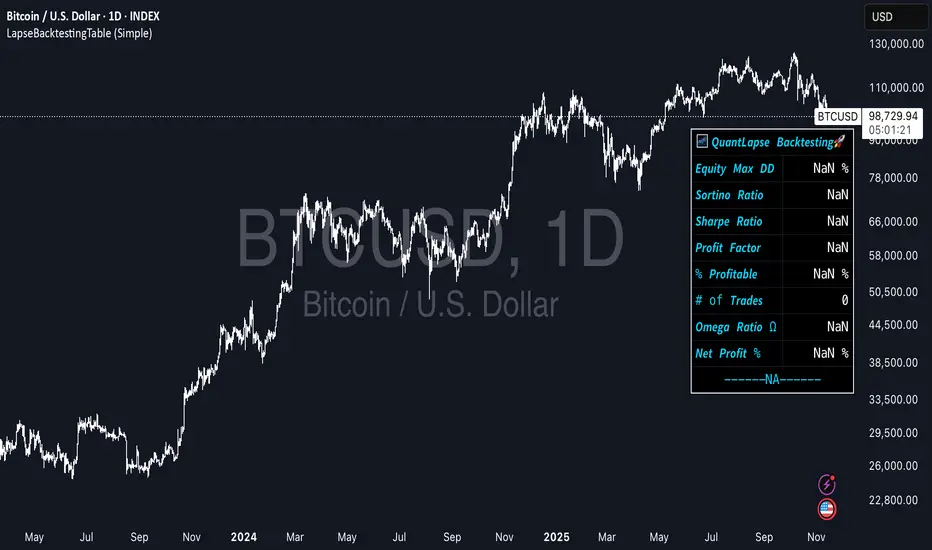
UTBotLibrary "UTBot"
is a powerful and flexible trading toolkit implemented in Pine Script. Based on the widely recognized UT Bot strategy originally developed by Yo_adriiiiaan with important enhancements by HPotter, this library provides users with customizable functions for dynamic trailing stop calculations using ATR (Average True Range), trend detection, and signal generation. It enables developers and traders to seamlessly integrate UT Bot logic into their own indicators and strategies without duplicating code.
Key features include:
Accurate ATR-based trailing stop and reversal detection
Multi-timeframe support for enhanced signal reliability
Clean and efficient API for easy integration and customization
Detailed documentation and examples for quick adoption
Open-source and community-friendly, encouraging collaboration and improvements
We sincerely thank Yo_adriiiiaan for the original UT Bot concept and HPotter for valuable improvements that have made this strategy even more robust. This library aims to honor their work by making the UT Bot methodology accessible to Pine Script developers worldwide.
This library is designed for Pine Script programmers looking to leverage the proven UT Bot methodology to build robust trading systems with minimal effort and maximum maintainability.
UTBot(h, l, c, multi, leng)
Parameters:
h (float) - high
l (float) - low
c (float)-close
multi (float)- multi for ATR
leng (int)-length for ATR
Returns:
xATRTS - ATR Based TrailingStop Value
pos - pos==1, long position, pos==-1, shot position
signal - 0 no signal, 1 buy, -1 sell

AlertSenderLibrary_TradingFinderLibrary "AlertSenderLibrary_TradingFinder"
TODO: add library description here
AlertSender(Condition, Alert, AlertName, AlertType, DetectionType, SetupData, Frequncy, UTC, MoreInfo, Message, o, h, l, c, Entry, TP, SL, Distal, Proximal)
Parameters:
Condition (bool)
Alert (string)
AlertName (string)
AlertType (string)
DetectionType (string)
SetupData (string)
Frequncy (string)
UTC (string)
MoreInfo (string)
Message (string)
o (float)
h (float)
l (float)
c (float)
Entry (float)
TP (float)
SL (float)
Distal (float)
Proximal (float)