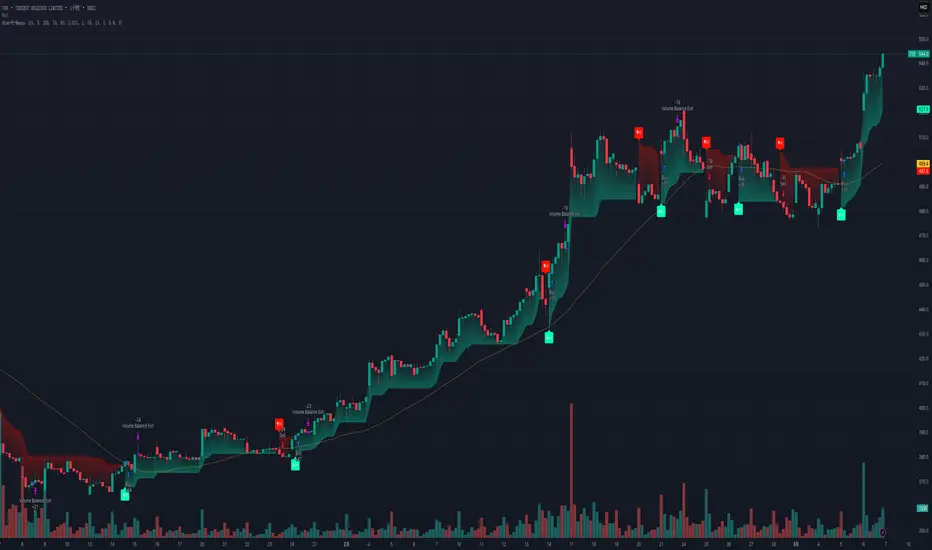
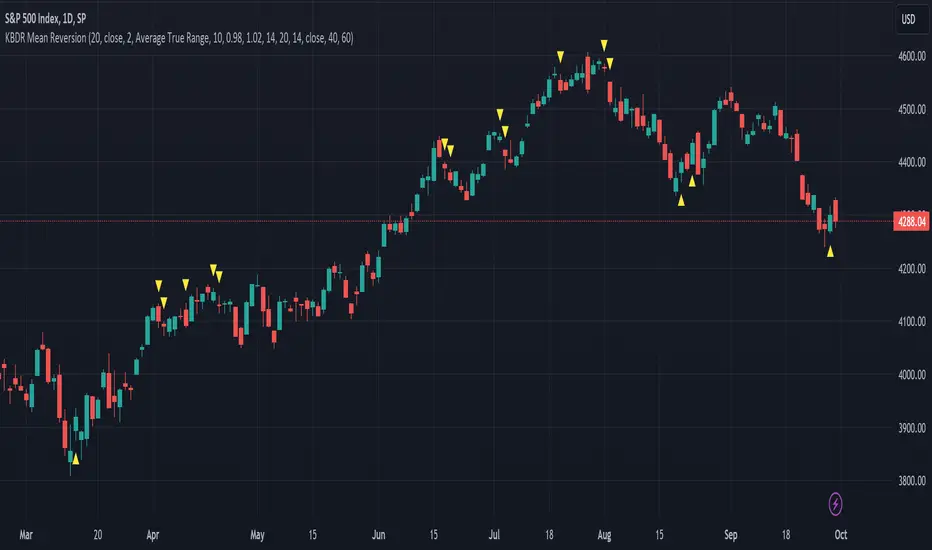
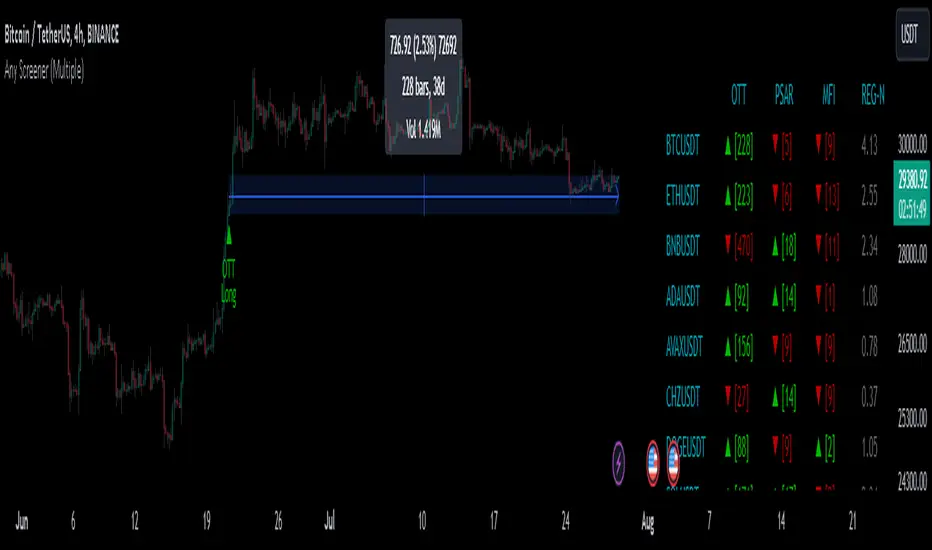
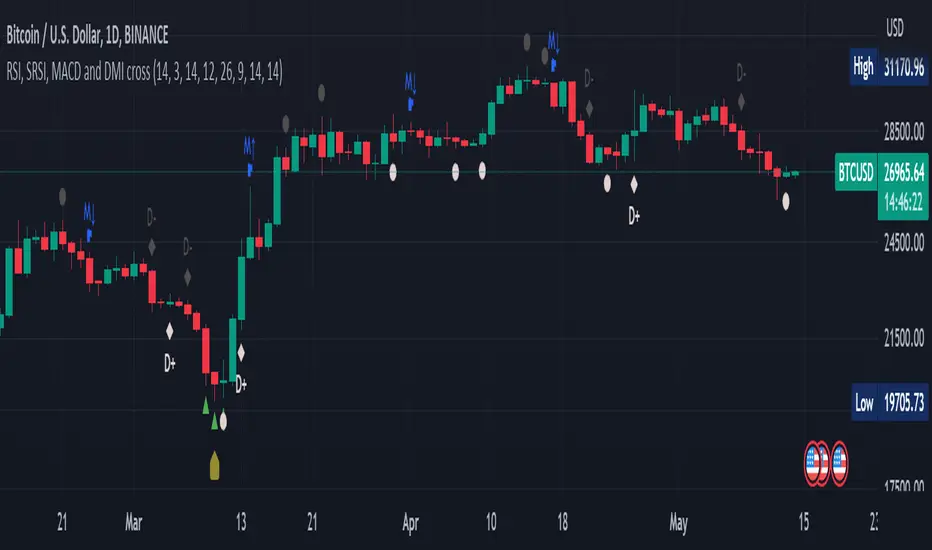
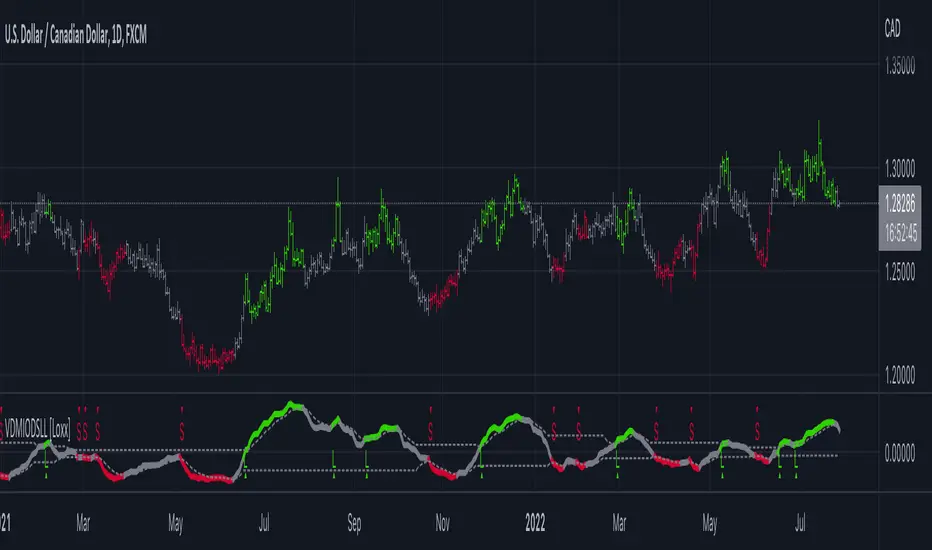
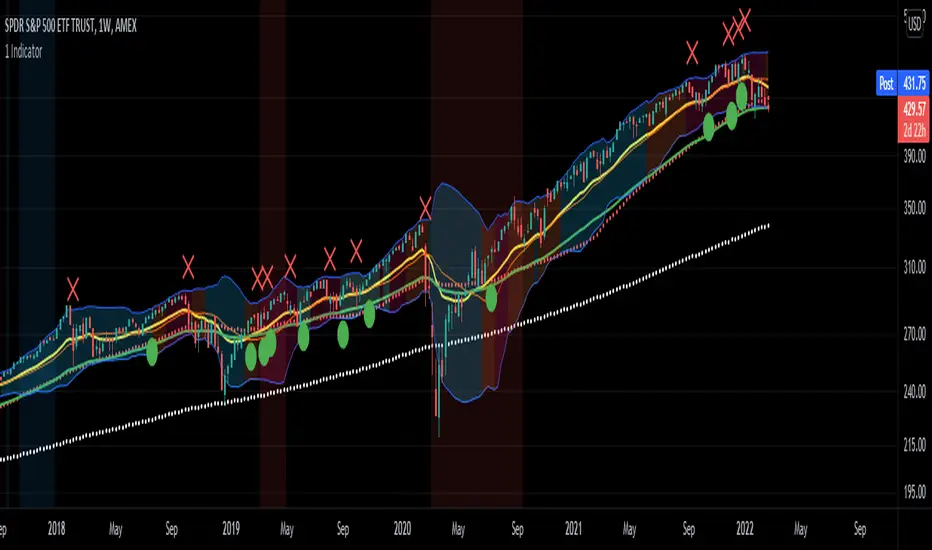
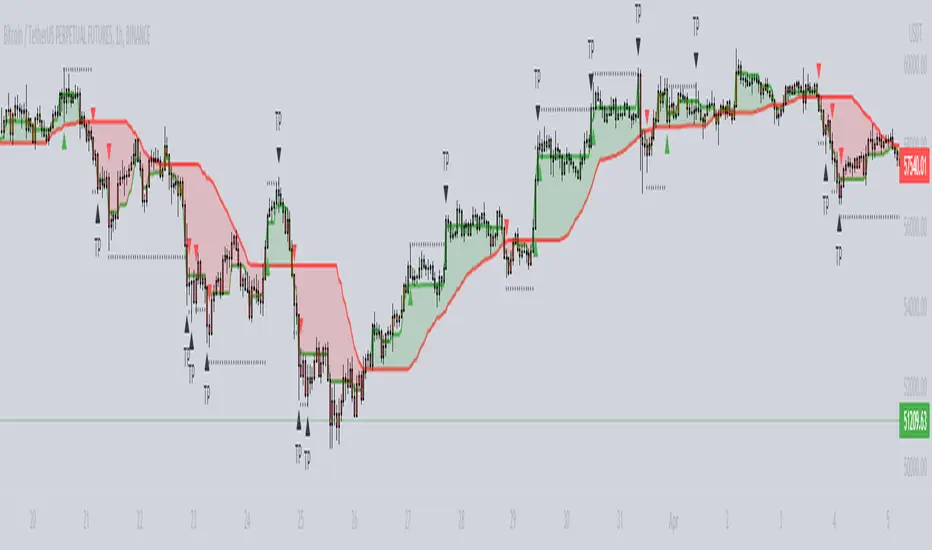
Directional Movement Index + Average Directional IndexPersonal DMI and ADX script
ADX color change from positive vs negative momentum
DMI Color fill based on DMI+/- positive momentum
No fill color during lack of momentum
Wyszukaj w skryptach "adx"
Apirine Slow Candlestick RSI [ChuckBanger]This is just a candle stick version of Apirine Slow RSI. The yellow line is Apirine Slow RSI with the option to set an offset to it to filter out nice. RSI oscillating between 0 and 100. And whats good with Apirine version is it generates both OB/OS signals and midline (50) cross over signals and divergences. As author suggests, bullish/bearish divergences generated by the indicator are not as effective during strong trends. To avoid fading an established trend, the system is used in conjunction with a trend confirmation tool like ADX indicator.
The script spits out red and green diamonds as a potential long and short signals when the yellow line crosses close of the RSI candles. And combine it with trend confirmation tool like ADX, and if you apply it correctly. You have a very robust trading system. Good luck traders
DAX Shooter 5M StrategyThis is a simple strategy that applies very well for scaling indices to 5 minutes especially for the DAX. The algorithm provides for buying or selling when the market is very "pulled". The rules are as follows:
you buy when:
1- The ADX indicator with the standard settings is greater than 32.
2- the RSI indicator set to 7 periods is crossing upwards the oversold line at 30
3- the candle minimum is lower than the lower band of bollinger bands set to 50 periods.
is sold when:
1- ADX indicator with standard settings is greater than 32.
2 - the RSI indicator set to 7 periods is crossing downwards the overbought line at 70
3- the maximum of the candle is higher than the upper band of the bollinger bands set to 50 periods.
Money management is at the discretion of the trader but usually it is better to set a fixed stop loss and a take profit on reaching the opposite bollinger band.
Enjoy trading at all!
90009If( MDI(14)>40 AND ADX(14)>40 AND PDI(14)<15 AND RSI(14)<30,1,0)
;If( MDI(14)<15 AND ADX(14)<15 AND PDI(14)>40 AND RSI(14)>70,-1,0)
Consolidation Zones (Range + ATR + optional ADX)Consolidation Zones — Market Compression Visualizer
Consolidation Zones is a visual market-structure indicator designed to identify periods of price compression where volatility contracts and directional movement pauses. These zones often precede expansion, breakout, or trend continuation, making them critical areas for trade preparation and risk planning. Instead of relying on a single oscillator, this script evaluates price behavior over time to detect when the market is moving sideways within a defined range. When consolidation is present, the indicator highlights the zone directly on the chart, allowing traders to immediately see where balance is occurring.
What This Indicator Helps You Do:
Identify low-volatility, sideways markets
Spot compression before expansion
Avoid entering trades during chop and noise
Prepare for breakout or breakdown scenarios
Combine structure with your existing trend or momentum tools
How to Use It
Inside the zone: Expect indecision and mean-reversion behavior
Break above the zone: Potential bullish expansion
Break below the zone: Potential bearish expansion
Use zone boundaries as context for entries, stops, and targets
This indicator is intentionally non-predictive — it does not guess direction. Instead, it provides clarity, showing where the market is coiling so you can act when price reveals intent.
Best Paired With
Trend indicators (EMA, VWAP)
Momentum tools (RSI, MACD)
Volume or volatility expansion tools
Notes
Consolidation is timeframe-dependent — zones may differ across intervals
Designed as a context tool, not a standalone signal generator
This indicator is for educational and informational purposes only.
Clean CPR v7.0 (Call & Put)// --------------------------------------------------------------------
// DESCRIPTION
// --------------------------------------------------------------------
// Clean CPR v7.1 is a multi-module trading and analysis toolkit built
// around Central Pivot Range (CPR) for intraday and swing trading.
//
// Core features:
// • Daily / Weekly / Monthly CPR with fills, labels and price display
// • Automatic CPR width classification (Super Narrow → Wide)
// • Visual alert when today’s CPR is WIDE (“WIDE CPR TODAY”)
// • Trade filtering: Wide CPR days are blocked from new entries
// • Pivot-based Support & Resistance (R1–R5, S1–S5, optional historical)
// • Developing CPR and Developing R1 / S1 levels
// • Previous Session High/Low with optional shaded zones
// • Dual Donchian Channels with auto-alignment coloring
// • Anchored Day-Open VWAP
// • Initial Balance (first hour range)
// • CPR + ATR + EMA + Fundamentals information table
// • Integrated 1H Call & Put breakout strategy with Supertrend, ADX,
// ATR trailing stop, targets, gap handling and time filters
//
// This script is designed as a single dashboard combining market bias,
// volatility, structure, and execution logic in one indicator.
// --------------------------------------------------------------------
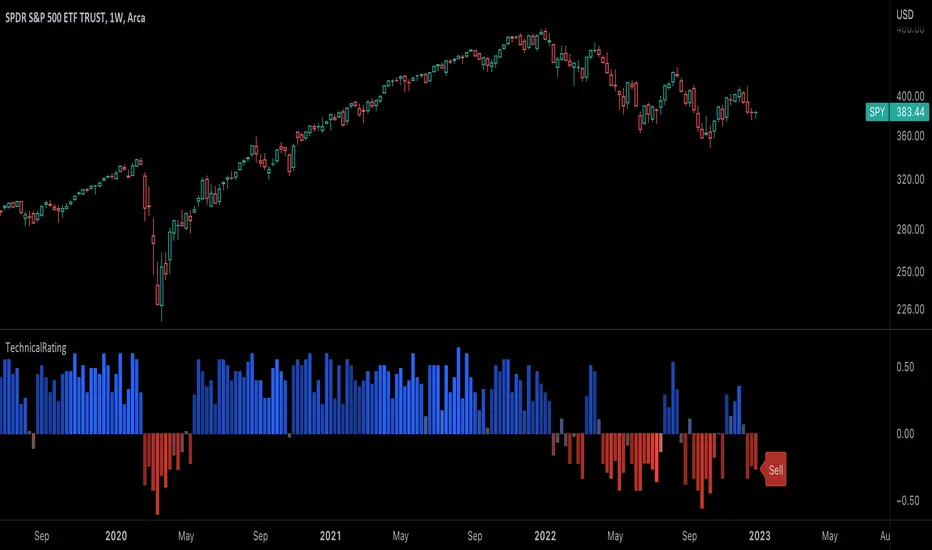
Market Trend AnalyserThis indicator identifies high-quality entries using market structure concepts such as Change of Character (ChoCH) and Break of Structure (BOS), rather than relying on lagging traditional indicators.
How to use :
Enter trades on ChoCH and BOS signals (both long and short).
To reduce market noise, it is recommended to apply:
An ATR filter with a minimum value of 1
An ADX filter with a minimum value of 15
You may also enable a moving average (MA) filter to avoid trading against the prevailing trend.
McGinley + Hull TrendMcGinley + Hull Trend — Synopsis
The McGinley + Hull Trend indicator is a fast, adaptive trend filter designed for intraday trading. It combines the Hull Moving Average for early trend detection with the McGinley Dynamic for volatility-adaptive confirmation.
Using short lengths (e.g. 10 & 10) on a higher timeframe such as 1-hour, the indicator identifies real directional intent early while filtering out VWAP and Bollinger Band fakeouts. Trades are best taken only when both Hull and McGinley slopes align, providing a clear bullish or bearish bias.
This tool is intended to be used as a trend-direction filter, not an entry signal, and pairs effectively with VWAP ±1σ, Bollinger Bands, and ADX for strength only on lower timeframes (e.g. 10-minute entries).
Apexflow PRO: Anchored Fair Value + Regime Readiness [v6]## Apexflow PRO — Anchored Fair Value Cloud + Regime Readiness (Non-Repaint Signals)
**Apexflow PRO** is an overlay indicator built to answer one core trading question:
**“Is price currently cheap, fair, or expensive — and is the market in a regime where that matters?”**
Instead of throwing random signals at you, Apexflow PRO combines **anchored fair value**, **market regime detection**, **flow participation**, and **optional cross-market confirmation** into a single, easy-to-read system with a **Readiness Score (0–100)** and clean, non-spam alerts.
---
# What you see on the chart
### 1) Anchored Fair Value Cloud (the “tunnel”)
This is the heart of the indicator.
* **Midline = Anchored VWAP fair value**
* Resets by **Day / Week / Month** (you choose).
* **Cloud = 3-layer adaptive tunnel**
* **Core (blue)** = “fair pricing zone”
* **Upper red layers** = increasingly stretched/expensive
* **Lower teal layers** = increasingly stretched/cheap
**Interpretation (beginner-simple):**
* **Inside blue core** → “priced fairly”
* **Below the tunnel** → “cheap / discounted”
* **Above the tunnel** → “expensive / premium”
* **Outer layers** → “extreme stretch” zones (higher snap-back risk)
### 2) Regime label (context filter)
Apexflow labels the market environment as:
* **TRENDING**
* **CHOP/RANGE**
* **VOLATILE**
* **BREAKOUT**
This prevents “using the right tool in the wrong market.”
Example: mean reversion works better in chop; trend continuation works better in trend/breakout regimes.
### 3) Readiness Score (0–100)
This is the **strength of confluence** between the engines.
* Low score = mixed signals / noise
* High score = alignment / higher-quality conditions
### 4) BUY / SELL signals (non-spam)
Signals trigger only when:
* **Readiness crosses above your threshold** (first bar only)
* **Regime filter agrees**
* **Structure agrees** (reclaim midline / lose midline OR location within the tunnel)
* **Cooldown** prevents rapid repeats
---
# What’s behind it (advanced, but readable)
Apexflow PRO uses four engines:
## A) Anchored Fair Value Engine (core)
A true anchored VWAP-style accumulator:
* Aggregates **price × volume** and **volume**
* Resets on your chosen anchor period
* Produces a stable “fair value spine”
### Stable Mode (important)
When **Stable Mode = ON**, Apexflow **does not drift intrabar** on live candles.
The anchored midline and tunnel update on confirmed bar closes to avoid the classic “wiggling anchor” problem.
## B) Regime Engine (Trend/Chop/Breakout/Volatile)
Uses multiple independent measures (not just one):
* **ADX** = trend strength
* **Efficiency Ratio (ER)** = trend efficiency vs chop
* **BB Width %Rank** = compression / squeeze context
* **ATR %Rank** = volatility regime context
This produces both a **regime label** and a **regime confidence score** used in the composite.
## C) Flow Engine (participation + intent proxy)
A blended participation model:
* **Signed candle pressure** (body vs range scaled by volume)
* **Wick rejection bias** (rejection strength)
* **RVOL** (relative volume lift)
This helps distinguish “real moves” from low-quality drifts.
## D) Cross-Market Confirmation (optional)
A light macro filter to reduce false positives:
* **Equities:** VIX (inverse risk)
* **Forex:** DXY (inverse USD pressure)
* **Crypto:** BTC.D (risk tone proxy)
If the cross-market symbol is unavailable, the script **falls back gracefully** and automatically reduces its weight.
---
# How to use (simple rules)
## Trend Following mode (default)
Best when you want to ride directional moves.
**BUY idea:**
* Readiness crosses above threshold
* Regime is **TRENDING** or **BREAKOUT**
* Price is reclaiming the midline OR is occurring from the lower half of tunnel
**SELL idea:**
* Same logic in reverse (lose midline / upper half)
**Practical beginner rule:**
> In Trend mode, treat the midline like “bias.”
> If price is above the midline and score is strong → favor longs.
> If below and score is strong → favor shorts.
## Reversion mode
Best in chop/range markets.
* Signals are biased toward **mean reversion**
* Use tunnel extremes as “stretch zones”
* Targets often gravitate back toward the **midline / inner bands**
---
# Best settings & timeframes (starting points)
These are practical defaults (not magic):
### Crypto
* 15m / 1H / 4H
* Anchor Reset: **Week**
* Threshold: **60–70**
### Equities / Indices
* 5m / 15m / 1H
* Anchor Reset: **Day or Week**
* Threshold: **60–75**
### Forex
* 15m / 1H
* Anchor Reset: **Day**
* Threshold: **60–75**
If signals feel too frequent: raise **Threshold** or increase **Cooldown**.
If signals feel too rare: lower **Threshold** slightly or reduce **Cooldown**.
---
# Alerts
Included:
* **Apexflow PRO Long**
* **Apexflow PRO Short**
These fire only when the indicator triggers a confirmed, threshold-cross event (designed for clean alerting).
---
# Notes & limitations (honest)
* This is not a “predict the future” tool — it’s a **context + fair value + confluence** system.
* Cross-market filters are helpful, but not universal. If you trade niche assets, consider turning cross-market OFF or customizing the reference symbol.
* Always use risk management. A strong score is not a guarantee.
GRA/Rei BRIA Simple [ReiConcept]BRIA SIMPLE - 22 Indicators Buy/Sell Signals
Get clear BUY and SELL signals based on the consensus of 22 technical indicators!
WHAT DOES IT DO?
BRIA Simple analyzes 22 indicators simultaneously and generates signals when a strong majority agrees on the direction.
22 INDICATORS IN 4 CATEGORIES:
MOVING AVERAGES (9): SMA, EMA (Short/Medium/Long), DEMA, TEMA, VIDYA
MOMENTUM (5): ROC, Momentum, TRIX, Price Oscillator, KST
OSCILLATORS (4): RSI, Stochastic, SMI, MACD
TREND (4): Parabolic SAR, DMI/ADX, Aroon, Elder Ray
HOW IT WORKS?
- BUY signal when 75%+ indicators are bullish
- SELL signal when 75%+ indicators are bearish
- Adjustable threshold (50-95%)
- Anti-repainting: signals confirmed at candle close only
FEATURES
- Clean BUY/SELL labels on chart
- EMA fill showing trend direction (cyan = bull, pink = bear)
- Bar coloring based on dominant direction
- Score table showing current consensus
- Built-in alerts for signals
SETTINGS
- Score Threshold: minimum % of indicators required (default 75%)
- EMA Fast/Slow: for trend visualization
- Show/Hide table and EMA fill
ANTI-REPAINTING
All signals are confirmed at candle close only. No repainting, no false signals during live candles.
This is a FREE simplified version. For advanced features like trailing stop, TP/SL management, and backtesting, check out BRIA Multi-Score Premium.
More tools: reiconcept.fr
Multi-Indicator Dashboard# Multi-Indicator Dashboard v3.7
## What Makes This Script Original?
This dashboard is **not a simple indicator mashup**. It implements a **unique multi-layer decision system** that combines three distinct methodologies into a unified framework:
1. **Ehlers' Laguerre Mathematics** - 18 weighted Laguerre filters with consensus voting
2. **Minervini's Trend Template** - Structural trend analysis using SMA relationships
3. **Defensive Voting System** - A 7-jury protection mechanism to prevent false signals
The key innovation is the **layered signal override architecture**: each layer can downgrade (but never upgrade) signals from the previous layer, creating a "safety net" that catches bull traps and false breakouts.
---
## How It Works: The 5-Layer Protection System
### Layer 1: Laguerre Consensus (Signal Generation)
The script calculates 18 Laguerre filters with gamma values from 0.10 to 0.95. Each filter "votes" bullish or bearish based on:
- Price position relative to filter
- Filter direction (rising/falling)
Votes are weighted by gamma (slower filters = higher weight). The **Effective Consensus** percentage determines the base signal strength.
### Layer 2: Market Filter (Macro Protection)
```
IF Reference Index (SPY/QQQ) < 200-day SMA
THEN Market = Bearish → Block ENTER signals
```
This prevents new entries during bear markets, regardless of individual stock strength.
### Layer 3: Regime Filter (Market Condition)
The script detects three market regimes using 7 criteria:
- ADX level (trend strength)
- DI+ vs DI- spread
- RSI position
- SMA convergence
- Volatility contraction
- Laguerre spread
**Choppy or Sideways regime** → Downgrade TREND/ENTER to CAUTION
### Layer 4: Protection Score (7-Jury System)
Seven independent "juries" vote on structural health:
| Jury | Condition | Meaning |
|------|-----------|---------|
| Laguerre | Close < Lag01 | Fast support broken |
| MACD | Histogram < 0 | Momentum negative |
| OBV | Trend = -1 | Volume selling |
| SMA20 | Close < SMA20 | Short-term trend broken |
| EMA Structure | EMA10 < SMA20 | Trend structure damaged |
| RS Line | RS < RS SMA50 | Underperforming index |
| Net Momentum | RSC < 50 | Sellers stronger than buyers |
**Scoring:**
- 0-1 points: Normal
- 2 points: Yellow Alert (TREND → WAIT)
- 3+ points: Red Alert (→ CAUTION)
### Layer 5: RSI Divergence Alert (Visual Warning)
When price approaches a 60-day high but RSI is 5+ points lower than at the previous peak, a warning icon (⚠️) appears. This **does not change signals** - it's informational only.
---
## Signal Interpretation
| Signal | Code | Meaning | Action |
|--------|------|---------|--------|
| 🟢 ENTER | 5 | Strong setup, all layers confirm | Consider entry |
| 🟢 TREND | 4 | Trend continues, structure intact | Hold position |
| 🟠 CAUTION | 3 | Warning signs present | Avoid new entries |
| 🟡 WATCH | 2 | Developing, too early | Monitor closely |
| ⚪ WAIT | 1 | Conditions unfavorable | Stay in cash |
---
## Key Indicators Explained
### RSC (Relative Strength of Change)
```
RSC = Sum of Positive Changes / Total Changes × 100
```
- RSC > 50: Buyers creating larger moves
- RSC < 50: Sellers creating larger moves
### Effective Consensus
Weighted average of 18 Laguerre filter votes. Higher gamma filters (slower, more reliable) have 2x weight compared to fast filters.
### LaRSI (Laguerre RSI)
Ehlers' smoothed RSI variant. Key zones:
- Below 0.20: Oversold (potential bottom)
- 0.30-0.55: Pullback zone (entry opportunity if turning up)
- Above 0.80: Overbought (caution)
---
## How to Use
1. **Check FINAL SIGNAL** - This is the output after all 5 layers process
2. **Read Status Row** - Shows which filter is currently active (if any)
3. **Monitor RSI Alert** - Orange color with ⚠️ means divergence detected
4. **Use Data Window** - Right-click chart → Data Window for all raw values
### Settings
- **Reference Index**: SPY for US stocks, BTCUSD for crypto
- **RS Lookback**: Period for relative strength calculation (default 50)
- **Filters can be toggled** on/off based on your strategy
---
## Important Disclaimers
- This indicator does not guarantee profits
- Past performance ≠ future results
- ENTER signal ≠ "buy immediately" - always confirm with your own analysis
- Risk management remains your responsibility
---
## Credits & Methodology Sources
- **Laguerre Filters**: John Ehlers, "Cybernetic Analysis for Stocks and Futures"
- **Trend Template**: Mark Minervini, "Trade Like a Stock Market Wizard"
- **CANSLIM**: William O'Neil, "How to Make Money in Stocks"
---
SilverHawk Pattern + Trend ScannerSilverHawk Pattern + Trend Scanner
This indicator scans for common candle patterns (Evening/Morning Star, Engulfing, Kicker) and displays adaptive trend channels (short/long) with strength metrics.
Features:
- Candle patterns with reversal/continuation % heuristic
- Adaptive trend channels (best short/long length selected by Pearson R)
- ADX trend power and channel alignment note
Settings:
- Show specific patterns: toggle visibility
- Channel lengths: auto-selected based on best correlation
- Alerts on pattern detection
Best used on H1 to D1 timeframes in Forex or indices for pattern confirmation and trend analysis. Use with proper risk management and confirmation.
Educational tool only. Not financial advice. Trading involves risk.
Deepsage1m + Tradingview15m Screener ComboThe Deepsage Consensus Screener — Long is a 1-minute momentum and trend confirmation indicator designed to generate high-quality long (buy) signals only when higher-timeframe market conditions are aligned.
The indicator combines a weighted multi-indicator scoring system (EMA, SMA, Ichimoku, MACD, RSI, ADX, volatility, volume, OBV, and VWAP) with a strict 15-minute consensus filter. Long signals are allowed only when the most recent confirmed 15-minute consensus state is BUY, ensuring trades are taken in the direction of broader market strength.
Deepsage1m + Tradingview15m Screener Combo (Shorts)The Deepsage Consensus Screener — Short is a 1-minute trend and momentum indicator built specifically for identifying short (sell) opportunities during bearish market conditions.
It uses the same weighted multi-indicator scoring engine (EMA, SMA, Ichimoku, MACD, RSI, ADX, volatility, volume, OBV, and VWAP) combined with a strict 15-minute consensus filter. Short signals are generated only when the most recent confirmed 15-minute consensus state is SELL, ensuring trades align with higher-timeframe bearish momentum.
Pro Volume & Momentum Dashboard [CONFIRMED ENTRY v2.1]🎯 Key Upgrades in This Version:
1. 10-Point Confluence Scoring System
# Factor Description
1 Volume Spike RVOL ≥ threshold with directional candle
2 Volume Delta Buy vs Sell pressure analysis
3 VWAP Position Institutional fair value
4 200 EMA Macro trend alignment
5 EMA Stack 9 > 21 > 50 alignment
6 ADX Trend strength + direction
7 RSI Momentum confirmation
8 MACD Histogram momentum
9 HTF Trend Higher timeframe alignment
10 Candle Quality Strong body, minimal wicks
2. Confirmed Entry Logic
✅ Requires minimum 7/10 confluence score (adjustable)
✅ Waits for candle close to avoid fakeouts
✅ 5-bar cooldown prevents duplicate signals
✅ Potential setups warned when score is 5-6/10
3. Risk Management
Auto-calculated Stop Loss (ATR-based)
Two Take Profit levels (TP1 & TP2)
Visual risk zones on chart
Risk/Reward ratio displayed
4. Higher Timeframe Confirmation
Checks 1H (or custom) timeframe trend
Ensures trade aligns with bigger picture
📌 How to Use:
Wait for ◆ CONFIRMED BUY/SELL label (not triangles)
Check dashboard for 7+/10 score
Entry: On signal candle close
Stop Loss: Red line below/above
Take Profit: Green lines (scale out at TP1, full exit TP2)
🕯️ Candlestick Patterns Added
Bullish Patterns (11 Total)
Pattern Description Strength
Bullish Engulfing Green candle engulfs prior red ⭐⭐⭐ Strong
Hammer Long lower wick at bottom ⭐⭐ Medium
Morning Star 3-candle reversal pattern ⭐⭐⭐ Strong
Bullish Harami Small green inside large red ⭐⭐ Medium
Piercing Line Opens gap down, closes above mid ⭐⭐ Medium
Three White Soldiers 3 consecutive strong green candles ⭐⭐⭐ Strong
Dragonfly Doji Long lower wick, no body ⭐⭐ Medium
Tweezer Bottom Equal lows at support ⭐⭐ Medium
Bullish Marubozu Full body, no wicks ⭐⭐⭐ Strong
Rising Three Continuation after pullback ⭐⭐ Medium
Bearish Patterns (11 Total)
Pattern Description Strength
Bearish Engulfing Red candle engulfs prior green ⭐⭐⭐ Strong
Shooting Star Long upper wick at top ⭐⭐ Medium
Evening Star 3-candle reversal pattern ⭐⭐⭐ Strong
Bearish Harami Small red inside large green ⭐⭐ Medium
Dark Cloud Cover Opens gap up, closes below mid ⭐⭐ Medium
Three Black Crows 3 consecutive strong red candles ⭐⭐⭐ Strong
Gravestone Doji Long upper wick, no body ⭐⭐ Medium
Tweezer Top Equal highs at resistance ⭐⭐ Medium
Bearish Marubozu Full body, no wicks ⭐⭐⭐ Strong
Falling Three Continuation after pullback ⭐⭐ Medium
Hanging Man Long lower wick at top ⭐⭐ Medium
Institutional Flow DetectorOverview
InstFlow 1S Delta identifies institutional order flow by analyzing volume anomalies and directional bias using 1-second sub-bar data. The indicator detects when large players are likely entering or exiting positions, providing actionable trade recommendations with confidence scoring.
Unlike traditional volume indicators that only show total volume, InstFlow breaks down each bar into 1-second micro-bars, classifies buying vs selling pressure, and identifies statistically significant volume events that likely represent institutional activity.
How It Works
1-Second Delta Analysis
The indicator fetches all 1-second bars within each candle and classifies each micro-bar as buying (close ≥ open) or selling (close < open). This achieves ~85-90% directional accuracy compared to ~55-65% from traditional bar-based methods.
Delta = Buy Volume - Sell Volume
Delta Ratio = |Delta| / Total Volume
Volume Anomaly Detection (Z-Score)
Volume is compared to a rolling 20-bar average using statistical z-scores:
- T1: Z-Score ≥ 1.5 (top ~7% of volume bars)
- T2: Z-Score ≥ 2.0 (top ~2% of volume bars)
- T3: Z-Score ≥ 3.0 (top ~0.1% of volume bars)
Signal Types
- Big Trades (T1/T2/T3) : Unusual volume with clear directional bias
- Absorption (ABS) : High volume + small price move + delta imbalance = hidden liquidity absorbing orders
- Exhaustion (EXH) : Capitulation pattern - big flush followed by immediate reversal with opposing delta
- Divergence (DIV) : Price and cumulative delta disagreeing over 5 bars
ACTION Recommendation System
Synthesizes all signals into a single trade direction (LONG/SHORT/WAIT) with confidence scoring (1-10):
- Exhaustion signals: +5 points (strongest reversal)
- Counter-trend absorption: +4 points
- Volume tier: +1 to +3 points
- Divergence confirmation: +2 points
- Strong trend (ADX>30): +1 point
- High delta imbalance (>50%): +1 point
Features
Real-time 1-second delta classification for accurate buy/sell detection
Statistical volume anomaly detection adapts to each instrument
Absorption detection finds hidden liquidity/iceberg orders
Exhaustion patterns catch capitulation reversals
Delta divergence warns of weakening moves
ACTION + Confidence system provides clear trade recommendations
Price-locked markers stay fixed at detection level (don't float)
Info table displays all metrics in real-time
RTH session filtering
Comprehensive alert conditions
Settings Guide
Detection Settings
Volume Lookback (20): Bars for calculating average volume and standard deviation
T1/T2/T3 Thresholds : Z-score thresholds for volume tiers. Lower = more signals.
1-Second Delta
Delta Resolution (1S): Use 1S for ES/NQ. Try 5S if 1S unavailable.
Min Delta Imbalance (10%): Minimum ratio to classify direction.
Absorption Detection
Min Volume Multiple (1.2x): Volume must exceed average by this multiple
Max Price Move Multiple (0.5x): Price move must be less than this × average range
Delta Imbalance Threshold (20%): Minimum delta ratio for absorption
Exhaustion Detection
Minimum Tier for Flush (T1): Required volume tier for the flush bar
New High/Low Lookback (10): Bars to check for price extremes
Min Reversal Size (0.3x ATR): Required body size for reversal bar
Divergence Detection
Divergence Lookback (5): Bars to compare price vs cumulative delta
Delta Trend Threshold (0.4): Sensitivity for divergence detection
How to Use
Add to ES, NQ, MES, or MNQ chart (1-5 minute timeframe)
Check 1S Data quality in table (green = 30+ bars = reliable)
Monitor ACTION field for trade direction
Use Confidence score for position sizing: HIGH (7+) = full size, GOOD (5-6) = standard, MED (3-4) = reduced
EXH signals are highest priority reversals
ABS + DIV combination is strong reversal confirmation
T2/T3 with trend are continuation signals
Avoid counter-trend T1/T2 without EXH/ABS/DIV confirmation
Visual Guide
Green circles below bar = Buy pressure (T1 small, T2 medium, T3 large)
Red circles above bar = Sell pressure (T1 small, T2 medium, T3 large)
Purple diamond + "ABS" = Absorption detected
Cyan label + "EXH" = Exhaustion pattern
Orange triangle + "DIV" = Delta divergence
Yellow background = Counter-trend warning
Best Practices
Trade during RTH (9:30am - 4:00pm ET) for most reliable signals
Wait for HIGH or GOOD confidence before full position
Use EXH as primary reversal trigger
Check cumulative delta supports trade direction
Combine with price action and support/resistance levels
Limitations
Requires 1-second data availability (ES, NQ, MES, MNQ have this)
ETH signals less reliable due to lower volume
EMA-based trend lags on sharp reversals
Not suitable for stocks without adjusting parameters significantly
Absorption/Exhaustion patterns may not occur every session
Disclaimer
This indicator is for educational and informational purposes only. It does not constitute financial advice.
Past performance does not guarantee future results
The indicator shows where institutional activity is LIKELY - it does not predict the future
Always conduct your own research and analysis
Never risk more than you can afford to lose
Paper trade any new strategy before using real capital
Neeson Crypto Cycle - Super Enhanced EditionThe "Neeson Crypto Cycle - Super Enhanced Edition": A Philosophical and Practical Framework for Market Analysis
Originality & Core Philosophy
Most trading indicators focus on a single domain: pure price action, a specific economic theory, or a handful of technical oscillators. The "Neeson Crypto Cycle" breaks this paradigm. Its fundamental originality lies not in inventing one new mathematical formula, but in architecting a multi-dimensional, multi-timeframe convergence framework. It operates on a core philosophical premise: financial markets are Complex Adaptive Systems (CAS) influenced by a symphony of concurrent cycles. These cycles range from mathematical and technical ones visible on the chart, to fundamental economic rhythms, down to collective human psychology and even speculative meta-patterns.
The script is built as a "dashboard of dashboards," attempting to quantify and visualize these disparate layers on a single pane. It does not claim predictive certainty but aims to provide a holistic situational awareness, allowing the trader to identify when multiple, unrelated cycles from different domains align (convergence) or conflict (divergence).
What It Does & How It Achieves It
The indicator functions as a comprehensive market-phase and sentiment analysis engine implemented directly on the TradingView chart. It is an overlay indicator that provides visual plots, background coloring, signal labels, and, most notably, extensive multi-table data panels.
Its implementation can be broken down into several operational layers:
1. The Core Technical Cycle Layer:
This is the foundational price-based engine. It simultaneously tracks multiple proprietary cyclical models derived from moving average crossovers with non-standard periods believed to capture crypto-specific rhythms.
CCT Pi Cycle: Uses the interaction between a 150-period EMA / 471-period SMA pair (for "bottom" identification) and a 111-period SMA / (350-period SMA * 2) pair (for "top" identification). It identifies golden/death crosses within these specific pairs.
Atlantean Signals: A variant using similar periods (471, 150, 350, 111) but with different multipliers (e.g., 0.745) and crossover logic to define "Market Bottom," "Bull Market Start," and "Market Top" events.
Bitcoin Cycle: Based on the interaction between a 116-period SMA and a doubled 365-period SMA.
Golden Pi Cycle: Another variant using SMAs of 111, 350, 150, and 471 periods.
These are not just four random moving average systems; they are distinct models targeting different aspects of the purported "Pi-based" and long-term cyclicality in Bitcoin's price history. The script visually plots these lines and labels their crossover events.
2. The Market Phase & Structural Context Layer:
Background Coloring: It dynamically colors the chart background (blue for "Bottom to Top" phase, orange for "Top to Bottom" phase) based on the sequential logic of Atlantean signals, providing immediate visual context for the perceived market regime.
Halving Event Annotations: It marks key historical and projected Bitcoin halving dates with vertical lines and labels, anchoring price action to this fundamental supply schedule.
3. The Quantitative Dashboard Layer (Technical & On-Chain):
This is where the script transitions from chart plotting to an information system. It renders multiple fixed tables on the chart (bottom-left, bottom-center, bottom-right) only on the last bar.
Technical Sentiment Dashboard (Right): A massive table aggregating over a dozen classic and advanced technical indicators (RSI, MACD, Bollinger Bands, Stochastic, ADX, Ichimoku, Parabolic SAR, Fibonacci levels, etc.). For each, it shows a calculated Status (e.g., "Overbought"), a numeric Value, and a concise Advice (e.g., "Sell"). It then groups these into "Cycle Indicators" (status of the core models above) and "Risk Management" metrics (Max Drawdown, Sharpe Ratio simulation, volatility).
Synthetic On-Chain Metrics Dashboard (Center): Since TradingView cannot pull real on-chain data, the script ingeniously simulates 80 different on-chain metrics (NVT, MVRV, Hash Rate, Exchange Flows, HODL Waves, S2F, etc.) by deriving them from price and volume data. Each metric displays a name, a simulated value, a signal ("Overvalued"), and a color code. This provides a proxy for the fundamental/network health narrative.
Multi-Cycle Systems Dashboard (Left): This table transcends traditional finance, cataloging the status of various long-wave cycles:
Economic Cycles: Kondratieff (50-60yr), Kuznets (15-25yr), Juglar (7-11yr), Kitchin (3-5yr), etc., each with a hardcoded current phase (e.g., "Recession (2020-2030)"), impact, and advice.
Speculative & Novel Cycles: Lunar, Seasonal, Commodity Super, Debt, and Innovation cycles.
Esoteric Systems: A full celestial (astrological) positioning of planets and a Four Pillars of Destiny (Bazi) reading, each with assigned market "impact" and "advice."
4. The Synthesis & Alert Layer:
Comprehensive Statistics: The right dashboard concludes with a tally of "Bullish vs. Bearish Signals" from across all technical and cycle indicators, generating an "Overall Sentiment" score.
Alert System: It creates TradingView alert conditions for every major crossover event from the core cycle models (CCT, Atlantean, Bitcoin, Golden Pi), allowing for automated notifications.
Underlying Calculation Logic & Rationale
The logic is built on convergence and weighted evidence. The creator's hypothesis appears to be that significant market turning points are rarely signaled by one indicator in isolation. Instead, they occur when:
Multiple Price-Based Cycle Models Align: When the CCT, Atlantean, and Bitcoin cycles all approach a "bottom" or "top" signal near the same time, the probability of a true phase change is considered higher.
Technical Conditions Match the Cycle Phase: A "Bull Market Start" signal is more credible if accompanied by oversold RSI/Stochastic, bullish MACD, and money flowing in (rising OBV).
The Macro Backdrop Supports the Narrative: The script hardcodes a specific macroeconomic worldview (e.g., "Tightening Credit Cycle," "AI Revolution Tech Cycle") to remind the user of the broader environment the price cycles are operating within.
Awareness of "Non-Rational" Drivers: By including astrological and Bazi elements, the script acknowledges that market narratives and crowd psychology can sometimes be influenced by or framed within these non-traditional systems. It doesn't necessarily predict with them but tracks them as potential sentiment catalysts.
The calculations for technical indicators are standard. The novelty is in their collective presentation and the synthetic creation of supporting data realms (on-chain, economic, esoteric) to form a complete, albeit highly speculative, "universe" of market-influencing factors.
How to Use It: A Practical Guide
This is not a "set and forget" system that generates simple buy/sell arrows. It is a decision-support and research tool.
Market Phase Identification: First, look at the background color and the status of the core cycle models in the right dashboard. Are you in a blue "Bottom to Top" phase? Check if the Atlantean "Bull Market Start" is active. This sets your primary bias.
Seeking Convergent Signals: Before acting on a cycle signal, cross-reference it with the Technical Sentiment dashboard. For example, an Atlantean "Market Top" signal is stronger if the RSI and Stochastic also show "Overbought," the MACD is "Bearish," and the Fear & Greed Index is in "Extreme Greed." Look for clusters of agreement.
Context from Other Dimensions: Check the On-Chain dashboard. Does the synthetic data suggest the network is "Overheated" or "Undervalued"? Check the Economic Cycle table. Does the perceived long-wave phase (e.g., "Kondratieff Recession") support a risk-on or risk-off stance? This provides narrative context for your trade thesis.
Risk Management Integration: Before sizing a position, check the Risk Management section. What is the current "Max Drawdown" and "Volatility Risk"? The dashboard suggests position sizing ("Light," "Medium," "Heavy") based on this.
Utilizing Alerts: Set alerts for the key cycle crossovers (CCT, Atlantean, etc.). When an alert triggers, it's your cue to open the chart and perform the full multi-dimensional convergence analysis described above, rather than acting on the alert alone.
In essence, the "Neeson Crypto Cycle" is a conceptual trading terminal. It posits that the modern trader, especially in crypto, must synthesize information from technicals, fundamentals, macroeconomics, and market psychology. By attempting to model all these facets in one place—even through estimation and simulation—it aims to give the user a structured framework for asking the right questions about the current state of the market, rather than providing simplistic, one-dimensional answers. Its value is in the breadth of its perspective and the discipline of multi-factor confirmation it encourages.
(5M) REG SuperTrend Pullback SystemThis indicator implements a rule-based SuperTrend pullback system
designed for short-term trend continuation.
Core features:
• Regression-based SuperTrend with flip detection
• Pullback + reclaim entry logic (non-repainting, bar-close confirmed)
• Regime filter (Trend vs Range suppression)
• Exhaustion detection to avoid late entries
• ADX + EMA bias alignment
• USDT Dominance risk filter (risk-on / risk-off)
• Clear BUY / SELL and Pullback AI-style entry labels
This is NOT a trading bot and does NOT place orders.
All signals are for analytical and educational purposes only.
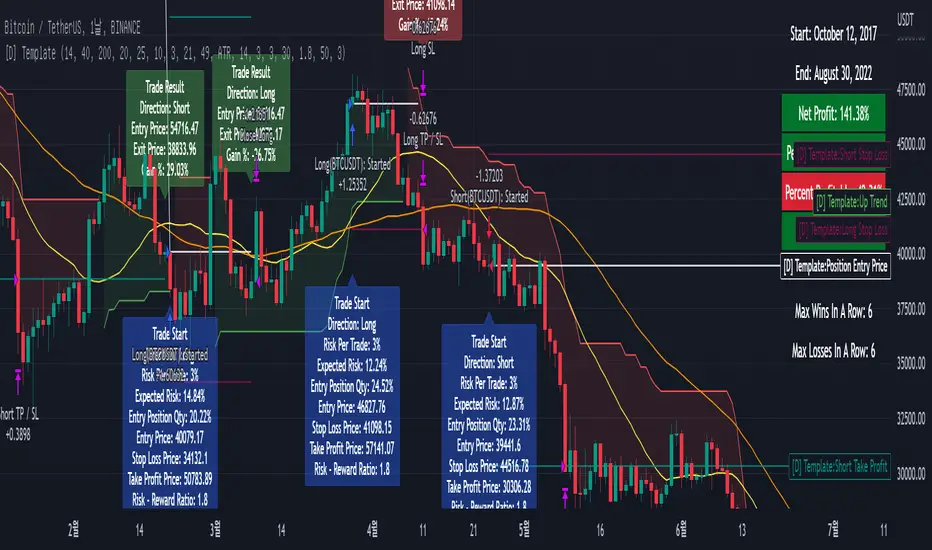
Dynamic Zone TraderDynamic Zone Trader - MACD-based trading system with adaptive stop loss and take profit zones.
This indicator generates buy/sell signals from MACD histogram crossovers and automatically adjusts position sizing based on market conditions.
Key Features:
Detects breakout trades and expands targets to capture larger moves
Identifies choppy/ranging conditions and tightens stops to reduce risk
Shows supply and demand zones based on pivot highs/lows
Displays three take profit levels (TP1, TP2, TP3) that scale with trade quality
Entry signals filtered by 50 EMA to trade with the trend
Signal strength score displayed on each entry marker
How It Works:
The indicator analyzes recent price structure and movement to classify each trade:
Breakout trades (breaking recent highs/lows) get 1.6x larger zones
Normal trades get standard 1.0x sizing
Choppy weak signals get 0.75x smaller zones
This allows you to take bigger positions on high-conviction setups while limiting risk during low-quality trades.
Settings:
MACD parameters (default 8/21/5)
Base stop loss: 60 ticks
Base take profit: 80 ticks
EMA filter: 50 period
Optional ADX trend filter
Adjustable breakout detection sensitivity
Works on any timeframe and instrument, but optimized for index futures like NQ/MNQ.
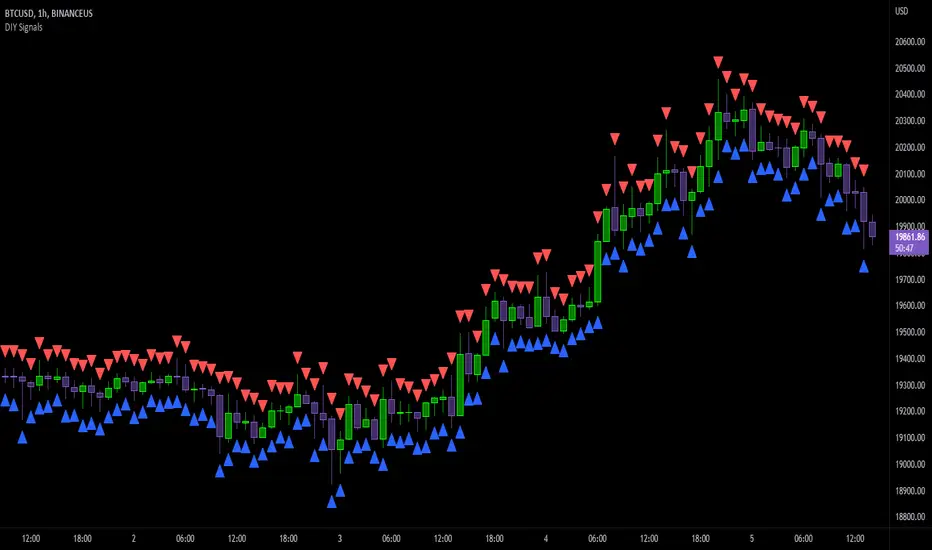
Absorption Pro V4This indicator detects absorption-style reversal setups and scores them with a multi-factor model.
It builds key levels from ZigZag/Fibonacci and round numbers across multiple timeframes, then flags potential absorption candles using volume and a delta-proxy filter plus strict candle-structure rules. Signals are validated with trend context (MA/SMMA/EMA/ATR), VWAP positioning, and optional momentum/volatility filters (RSI, Stoch, CCI, MACD, ADX, Volume Profile). Only score-threshold crosses can trigger long/short markers and alerts (defaults tuned for NQ).
MTF Indicator DashboardMulti-Timeframe Indicator Dashboard
A comprehensive multi-timeframe dashboard that displays the status of key technical indicators across 8 different timeframes in a compact, color-coded table.
Features:
Monitors 8 timeframes simultaneously: 3m, 5m, 15m, 30m, 1H, 2H, 4H, and Daily
Tracks 5 key indicators:
RSI (2-period with 6-period smoothing): Green when above 50, Red when below 50
ADX/DI (2-period): Green when +DI > 20 and dominant, Red when -DI > 20 and dominant
MACD (2, 3, 6): Green when MACD line above signal line, Red when below
EMAs (9, 20, 50, 100, 200, 400): Green when price above all EMAs, Red when below all EMAs
Overall: Combined signal requiring 2+ indicators to agree for bullish/bearish confirmation
Display:
Clean, compact table positioned in top-right corner
Color-coded boxes: Green (bullish), Red (bearish), Gray (neutral)
Minimal visual clutter for quick analysis
Updates in real-time
Use Case:
Perfect for traders who want to quickly identify timeframe alignment and confluence across multiple technical indicators. Ideal for scalping, day trading, and swing trading to spot high-probability setups when multiple timeframes align.
Settings:
All indicator parameters match the calculations used and can be viewed in the source code.
EURUSD 15mThis strategy is a EURUSD 15-minute trend-following signal indicator built around an EMA “basis” and ATR volatility bands. It uses a 20-period EMA as the midline and ATR to form inner/outer channels, helping identify pullbacks and avoid chasing extremes. A 150-period EMA acts as the trend filter, and signals are only considered in the direction of the trend (optionally requiring the trend EMA to slope). Quality filters include ADX strength, a confirmation candle rule, a volatility filter (ATR vs ATR moving average), a “room to outer band” filter, plus anti-spam arming and a cooldown timer to reduce repeated signals. The main entry logic is DR (deep retracement back to the basis and reclaim) with an optional BO (breakout across the inner band) feature. Mode presets (More Trades / Balanced / Quality) adjust strictness to trade off frequency versus selectivity.
Volume SMA 9 / 20 / 50This is real time volume average lines having option to select period of volume lines . it not only provides volume with respect to price action but also we can find out real picture of price action pressure. use it with ADX and MACD wisely . only volume spike is not confirmation some times fake breakout , so wait for confirmation and participate at breakout confirmation.